
 Image Credit: ©Vicky Design via Canva.com
Hello,
Thanks for checking in to another awesome Zed Labs blog article.
This tutorial is a thorough and highly professional guide, that details a standard and complete deployment of a NodeJs API server on AWS EC2.
It's a highly packed piece that'll expose you to some very important technologies, that you'll be using on different server/virtual-machine chores as a cloud/DevOps engineering professional.
What You'll Be Learning.
In this tutorial, you'll learn:
- About managing servers on AWS EC2.
- About Nginx: how to deploy and use it as a reverse proxy, and as a tool for generating free SSL certificates for your domains.
- About Route 53 - AWS' DNS management service.
- How to make a standard virtual machine Node installation - with NVM, so as to afford you the ability to use different Node versions whenever the need arises.
- About "Systemd" - a Linux OS system and service manager. A very powerful tool that if well understood, helps you stand-out as a cloud/DevOps engineer.
- More...
We'll be deploying this Node/Express project that I already prepared. Access the project repository using the link below.
The above project that we'll be deploying, was bootstrapped from this fully-typed multi-database NodeJs/ExpressJs template that I created. Explore it, and feel free to use on you new Node/Express projects. Contributions, stars, and feedbacks are welcomed.
N.B: This guide assumes, that you already created an EC2 instance, and is ready for the API server deployment. In case you haven't and need a guide to go about that, explore this awesome Zed Labs blog article, in which I shared how to create an AWS EC2 instance from scratch. Awesome thing, the EC2 instance I created in that post, is the one I'll be performing this project server deployment on.
The Project To Be Deployed.
The project to be deployed, is currently fully set up. It will connect to a live AWS RDS PostgreSQL database instance, and it currently has five active end-points. We'll handle environment secrets professionally of course.
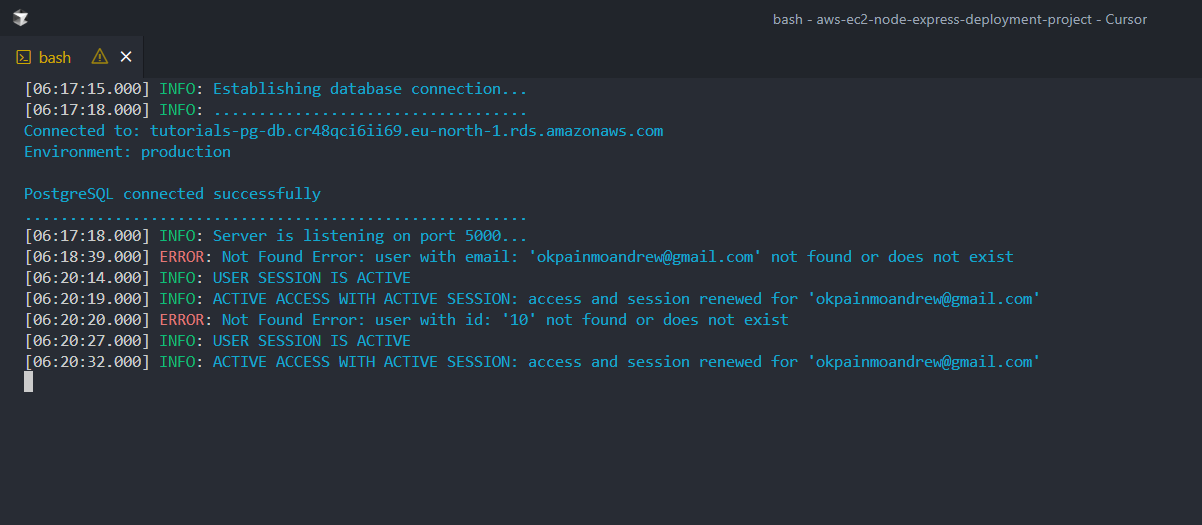
The below screenshot is a terminal instance that shows how things should look in our server/virtual machine logs after a successful deployment.
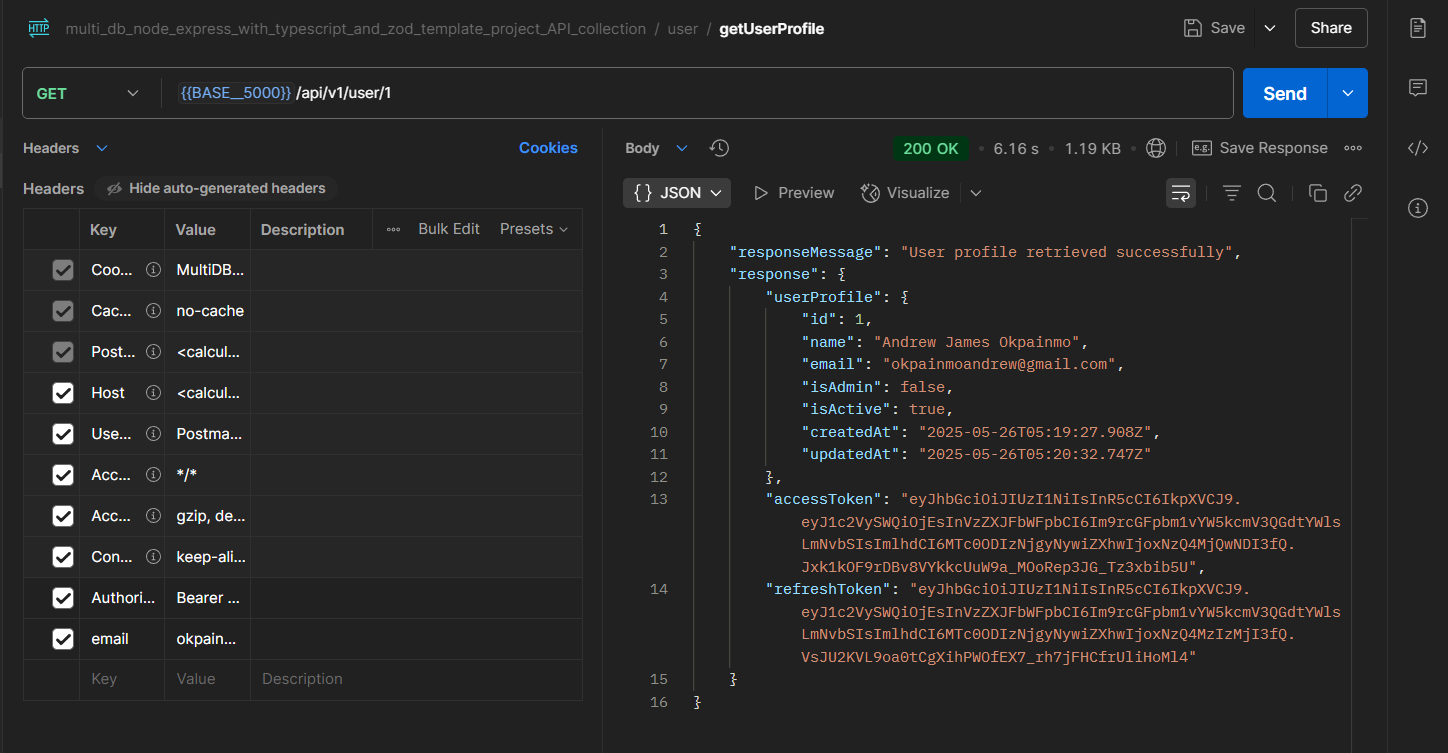
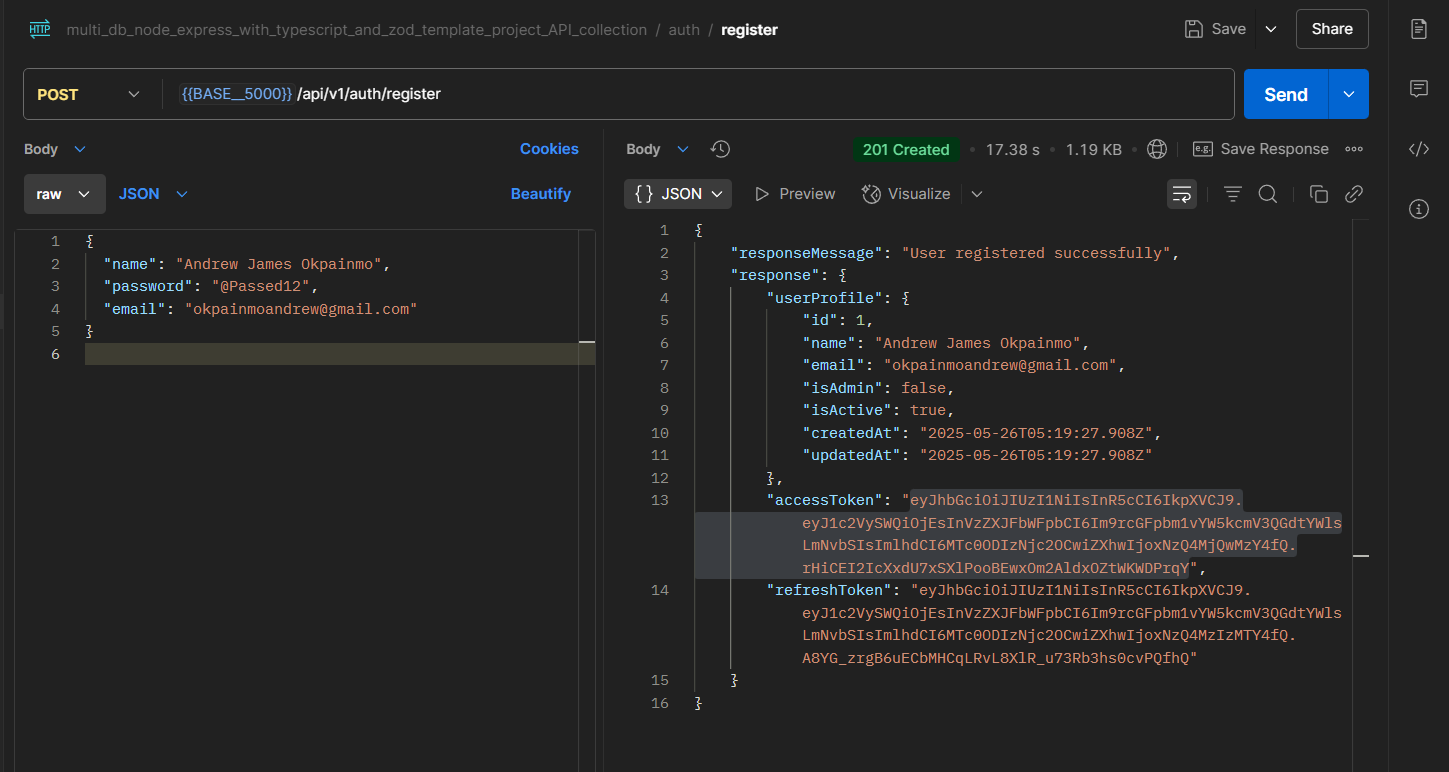
The two screenshots below, reveal Postman interfaces with two requests that were made on the local/testing deployment of the API on my machine. Once done with our deployment, we'll update the request URLs, and try out with our live API URL.
Let's Get A Todo.
- Access EC2 instance via SSH and perform system updates/upgrades.
- Install NVM and the latest NodeJs LTS version.
- Clone project repo and explore the project.
- Make all project dependency installations, and run the API server.
- Create a temporary .env, and add environmental variables(not very secure, we will implement in a more secure way on step 11).
- Open VM port '5000' and temporarily test the API server on it.
- Install Nginx, set up as reverse proxy, and access the API server through it. Follow up and close the VM port 5000.
- Get a free SSL certificate for project domain(sub-domain) - api.tutorials.zedlabs.xyz.
A perfect sub-domain, would have been api.zedlabs.xyz, but unfortunately I already have that set up for another project. Also, feel free to skip every domain/sub-domain related parts in-case you don't have one.
- Test API server on the new sub-domain.
- Explaining what happens with the current setup if something goes wrong.
- Set up a system service(for server persistence) using Systemd.
- Finish deployment, and test API server on the live URL - inside Postman.
Now Let's Get To Work.
1. The Access EC2 instance via SSH and perform system updates/upgrades.
1ssh -i <path to SSH key-pair> ubuntu@<public IP or Public DNS of the instance>- Connect to the instance using your public key auth string. Mine would be as below.
1ssh -i /c/directory-name/another-directory-name/SSH/tutorial-instance-key-pair.pem ubuntu@ec2-13-60-96-165.eu-north-1.compute.amazonaws.com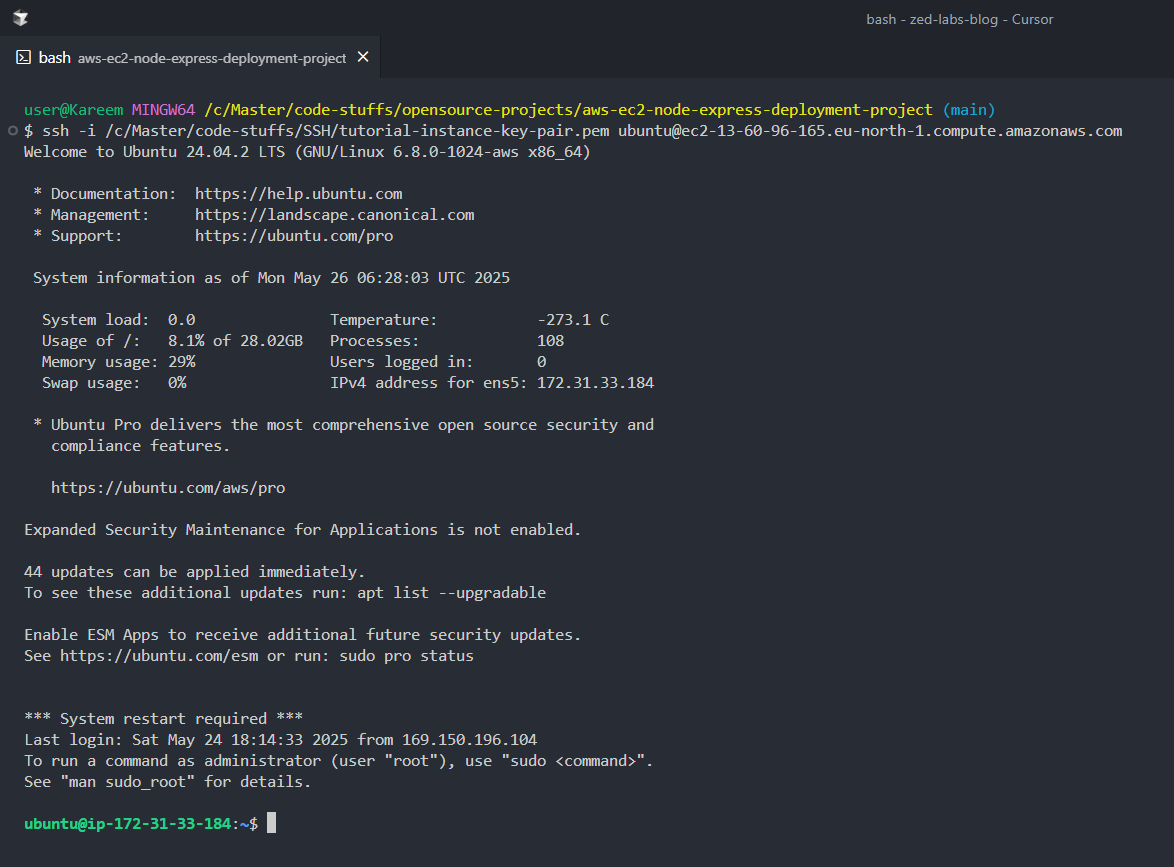
- Perform necessary system update/upgrades.
1sudo apt update && sudo apt upgrade -y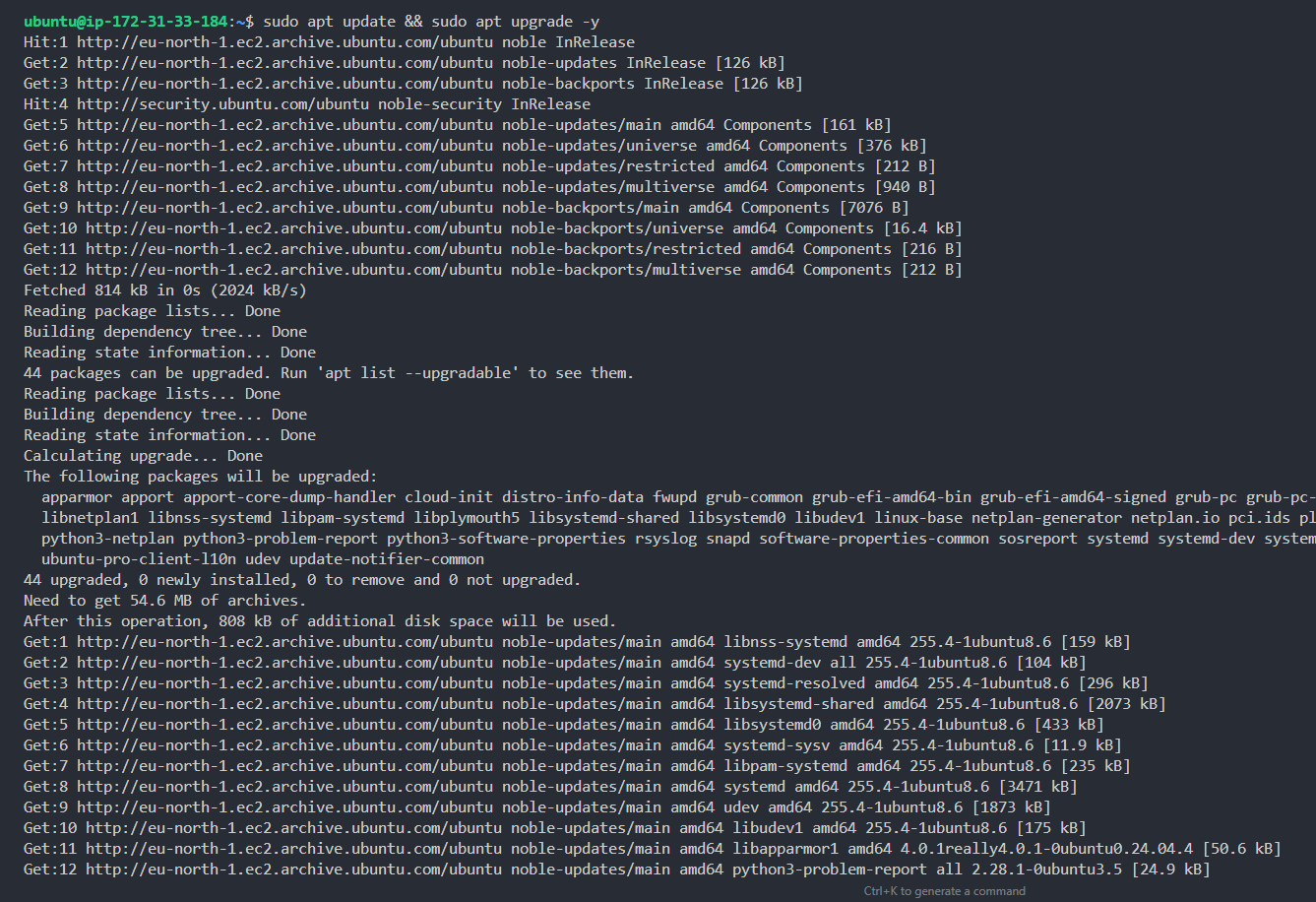
2. Install NVM and the latest NodeJs LTS version.
- Download and run the NVM install script - The VM comes pre-installed with Git.
1curl -o- https://raw.githubusercontent.com/nvm-sh/nvm/v0.39.7/install.sh | bash- Load NVM (add this to your shell config if needed).
1
2export NVM_DIR="$HOME/.nvm"
3[ -s "$NVM_DIR/nvm.sh" ] && . "$NVM_DIR/nvm.sh"
4- Verify NVM installation.
1nvm --version- Install latest Node LTS version.
1nvm install --lts- Making sure to use the newly installed LTS NodeJs version.
1nvm use --lts- Verify NodeJs.
1node -v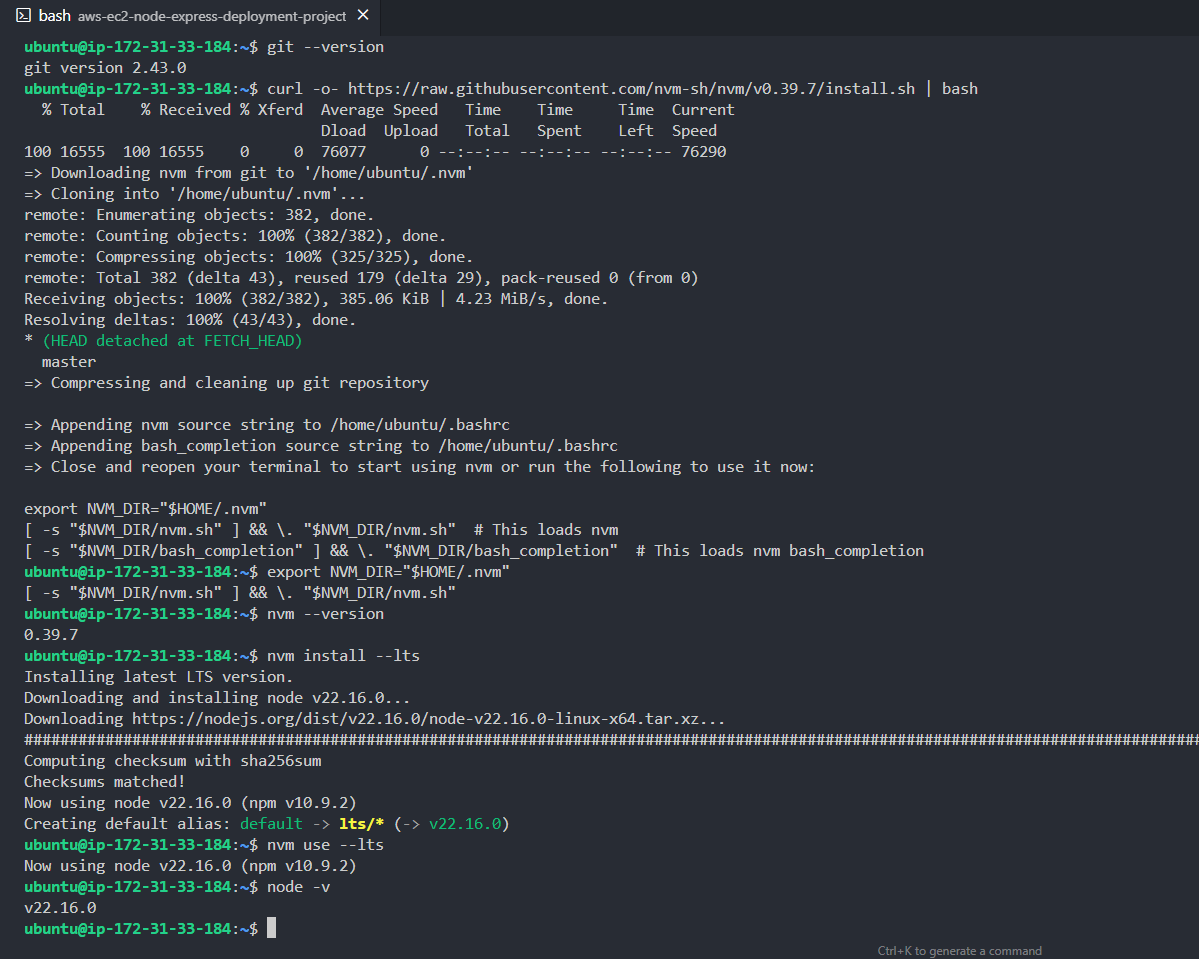
- Verify NPM.
1npm -v3. Clone project repo and explore the project.
- Our EC2 VM comes with Git pre-installed, we'll now simply access and clone in the repo.
1git clone https://github.com/Okpainmo/aws-ec2-node-express-deployment-project- Explore the cloned project folder.
1cd aws-ec2-node-express-deployment-project1ls4. Make all project dependency installations, and run the API server.
- Make dependency installations.
1npm install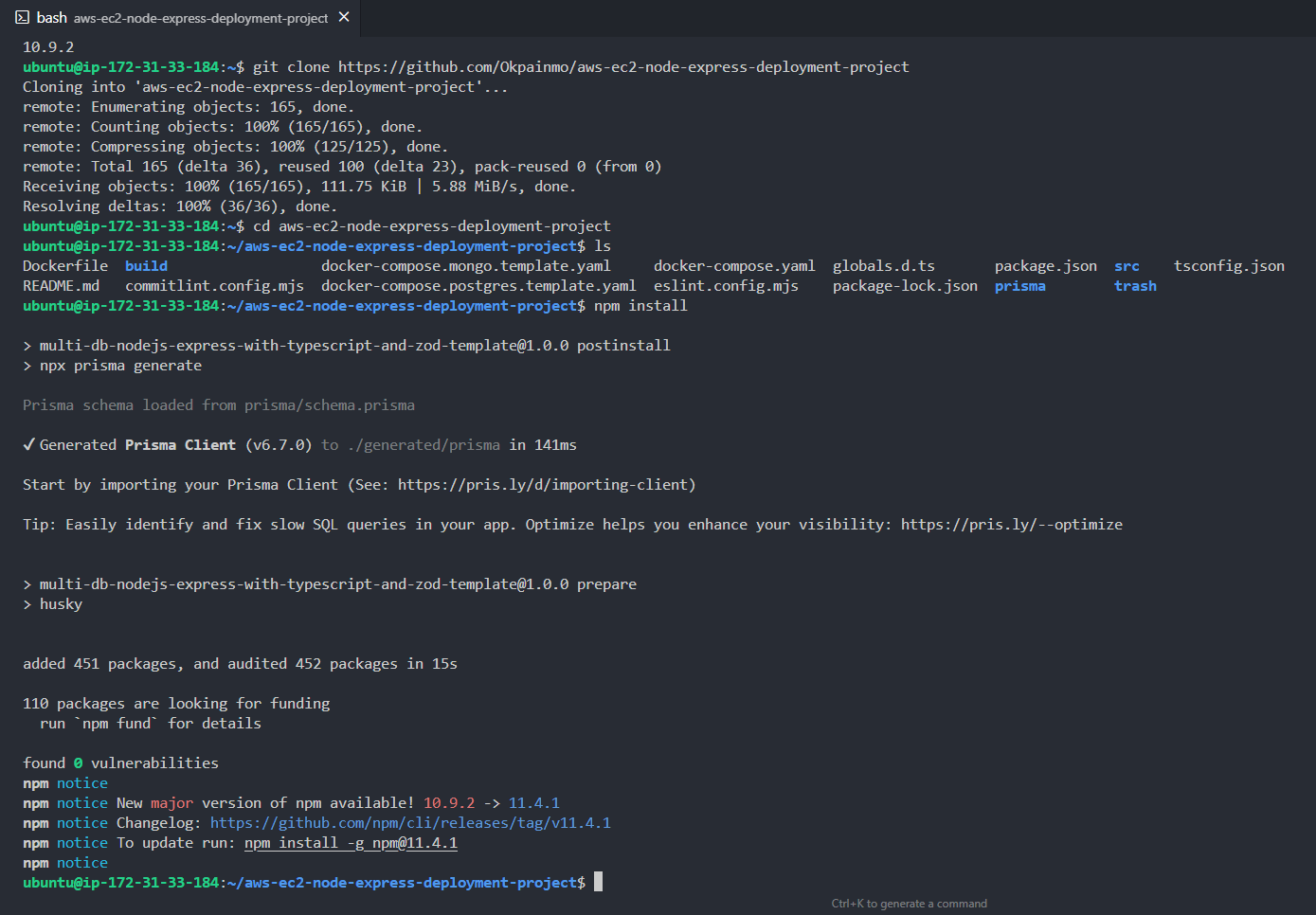
- Run the project server.
1npm run dev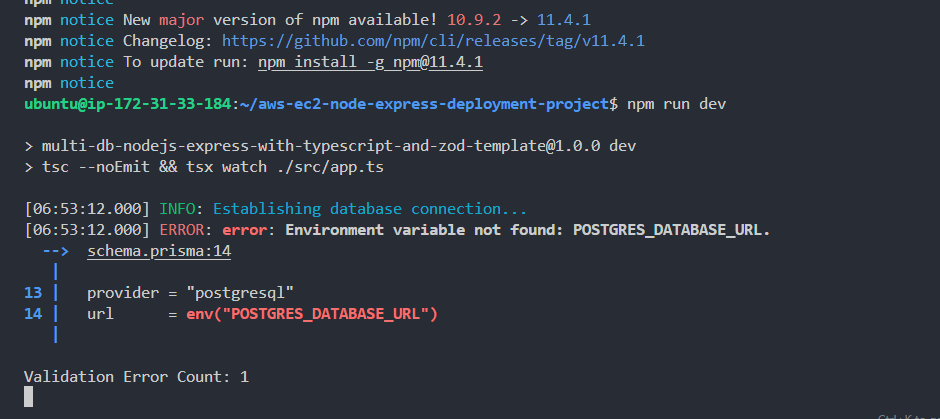
As you can see from the screenshot above, our project server is currently running, but is throwing an error due to absence of the PostgreSQL DB environmental variable.
- Press CTRL + C to terminate the process, so we can fix that.
5. Create A Temporary .env, And Add Environmental Variables - NOTE VERY SECURE - WE WILL REMOVE IT ON STEP 11.
- Create a temporary .env file.
1echo "KEY=value" > .env- On running the ls command, you won't find the .env file that was just created, because it's actually hidden. Run the below command, and you'll see that it was actually created.
1cat .env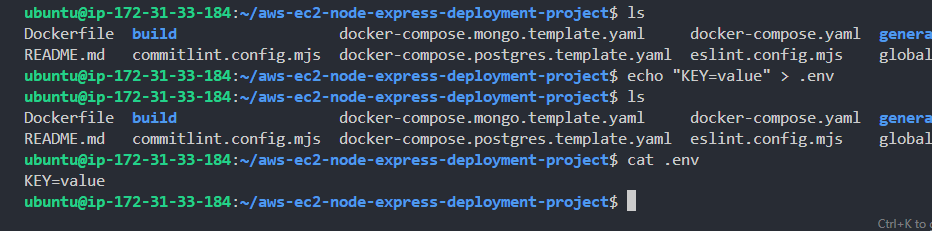
- Open the .env file with the Nano CLI editor, clear the previous insertion, and add the real environmental variables.
1sudo nano .envIn my case, it is as in the below screenshot.
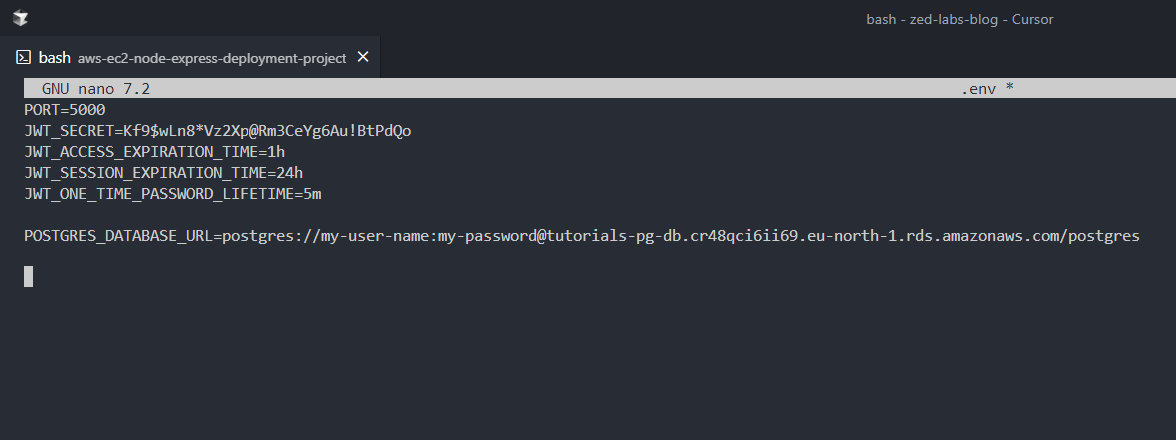
- Save Nano and exit - CTRL + o then press Enter then CTRL + x
Now restarting the server, you will see that everything works fine - with the database successfully connected.
1npm run dev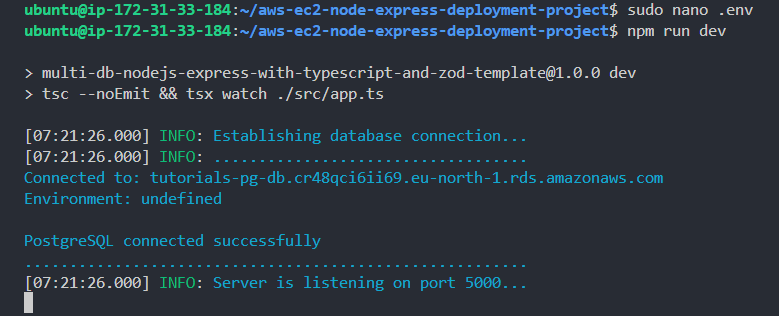
Environment shows undefined because I failed to add/specify it in the .env. Simply add it if you wish.
1
2DEPLOY_ENV="production"
3
6. Open VM port '5000' and temporarily test the API server on it. Also open the VM port '80' and '443' for HTTP and HTTPS requests respectively.
With the current set up, our API server is already running on the VM port '5000'. But since the port is not yet accessible, we still won't be able to reach the API server on any address.
Now to help you understand things better, we will do something unsecure. But as expected, we will undo and clean it up later.
Let's proceed to our VM security-groups on AWS, and open up port 5000. So that we can access our currently running API server from the outside.
- Proceed to your VM dashboard on EC2.
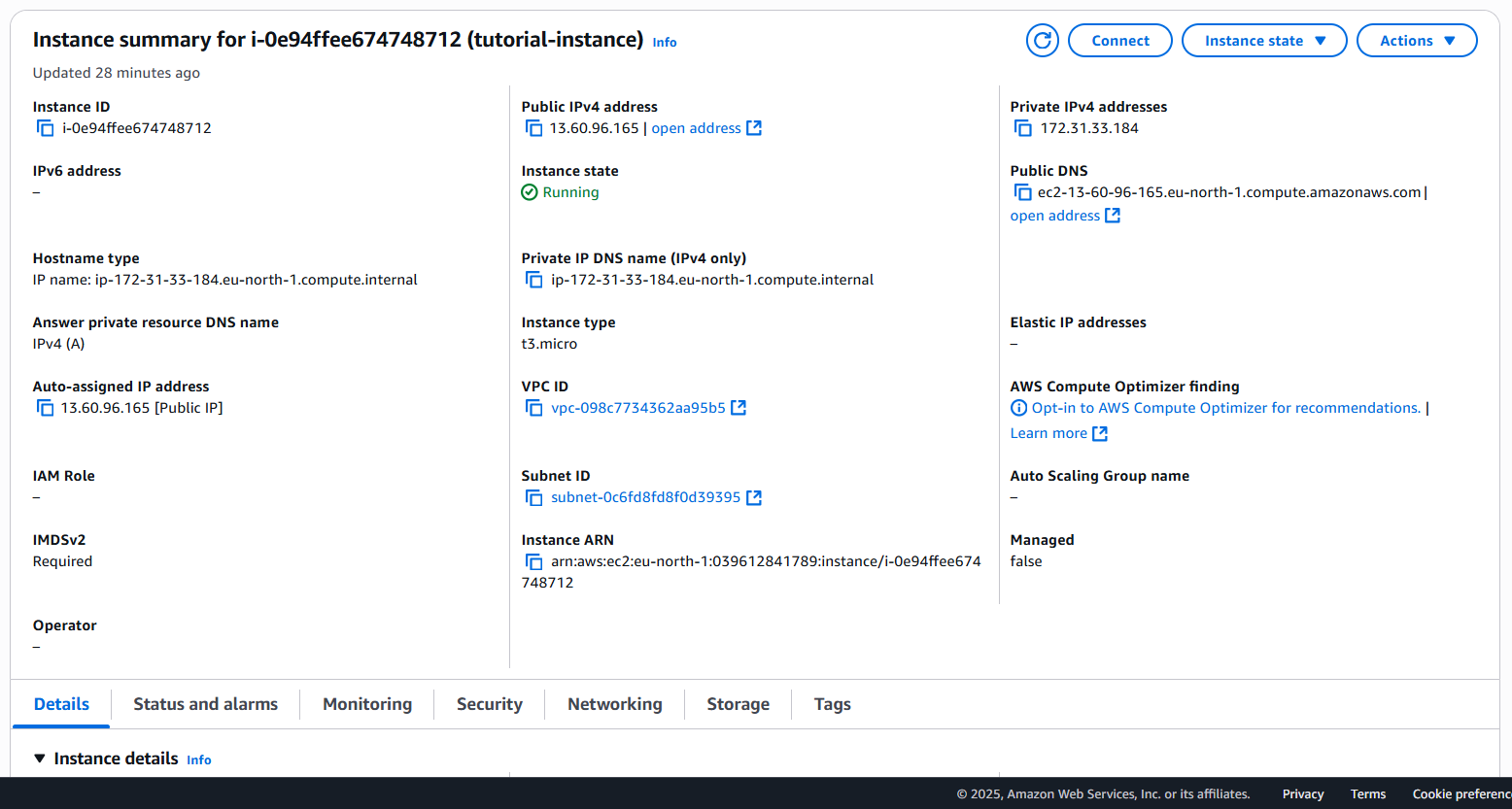
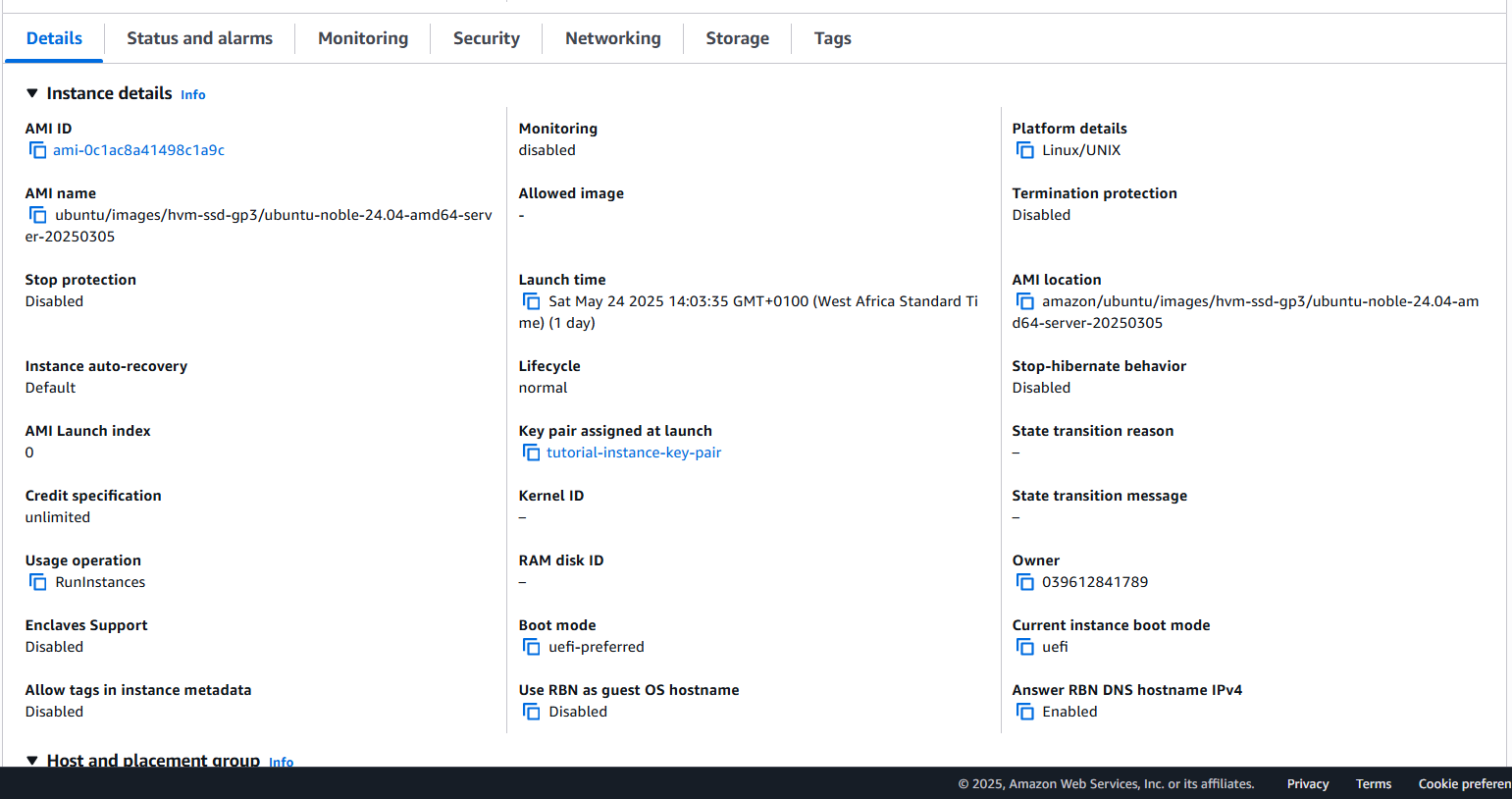
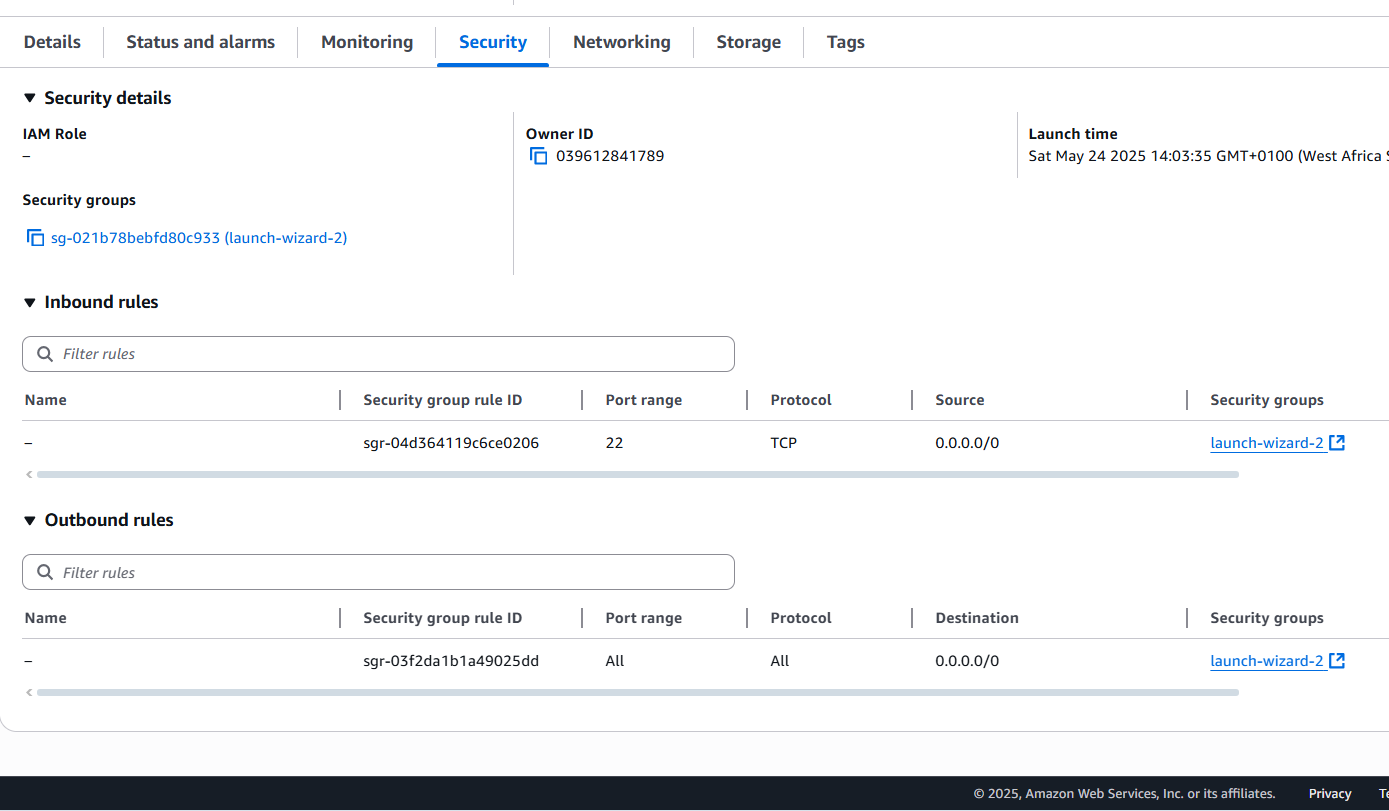
- Scroll to the bottom of your instance page, and click on security from the menu.
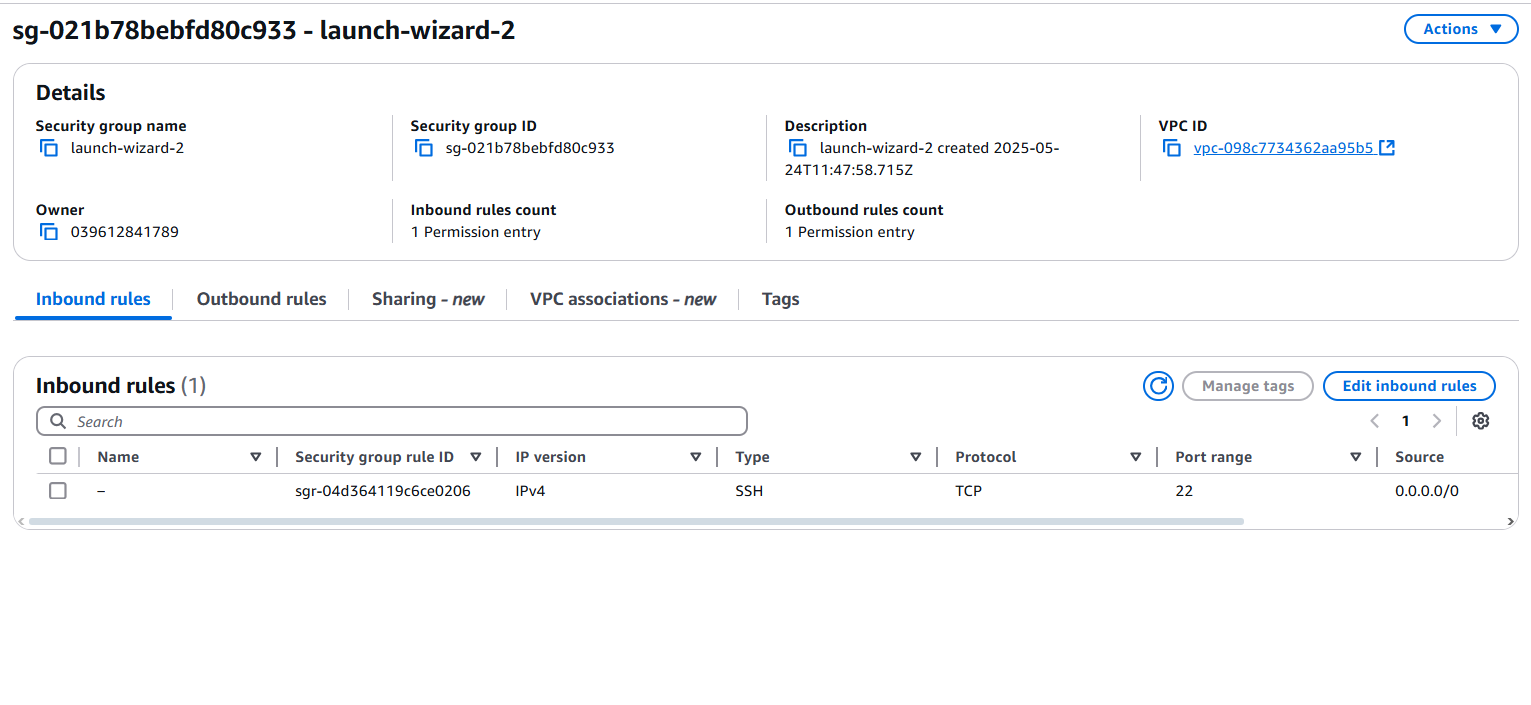
Locate the Security groups link ("sg-021b78bebfd80c933 (launch-wizard-2)" in my case) and click on it.
On the Inbound rules section, click on the "Edit inbound rules" button that is towards the right side of the screen.
Click on the "Add rule" button, and open the VM port 5000 with the following update - as you can see below. Then click the "Save rules" button to save the changes.
- Type: Custom TCP
- Port Range: 5000
- Source: Anywhere-IPV4
We'll also be opening the VM port 80(HTTP) and port 443(HTTPS) to accept incoming http and https requests respectively.
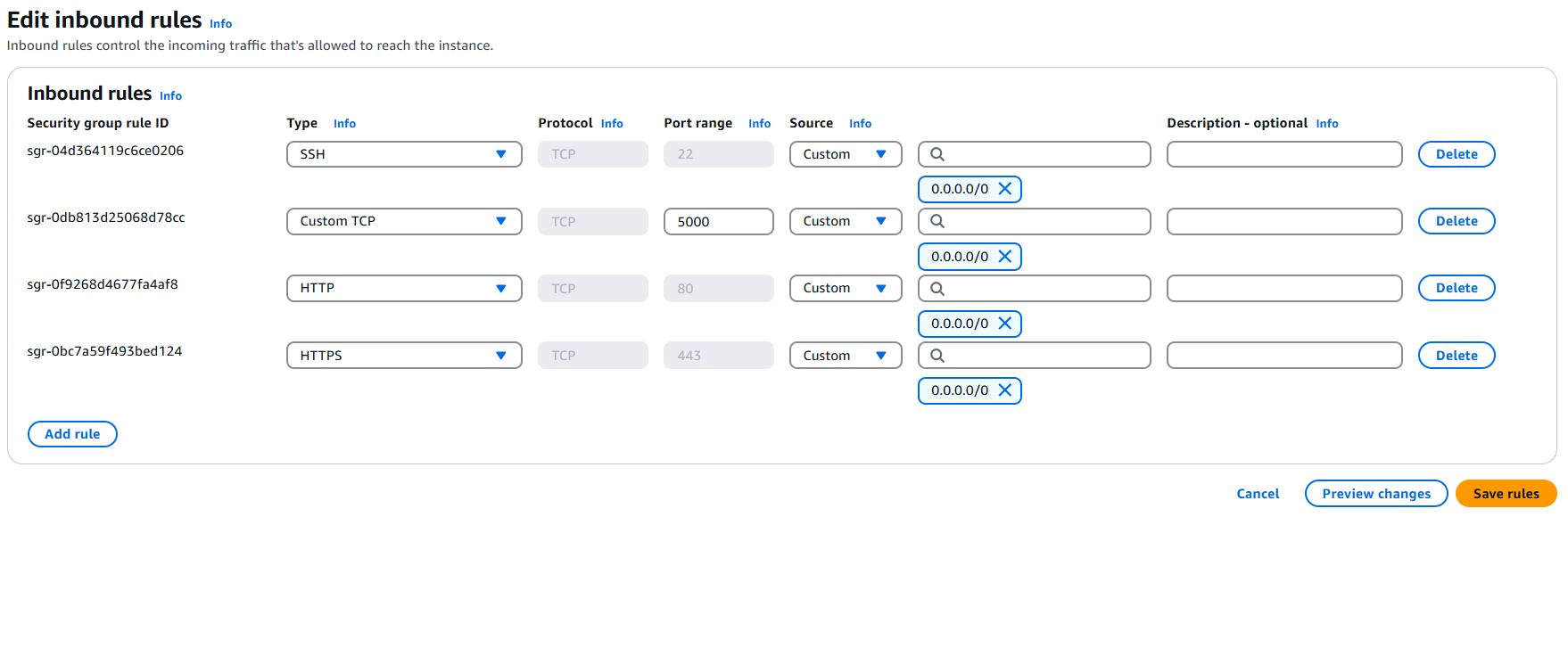
Note that while doing that is similar to opening the VM port 5000, it's quite different and necessary, else our VM won't be able to accept incoming http and https requests.
- Type: HTTP
- Port Range: 80(will be automatically selected)
- Source: Anywhere-IPV4
Then
- Type: HTTPS
- Port Range: 443(will be automatically selected)
- Source: Anywhere-IPV4
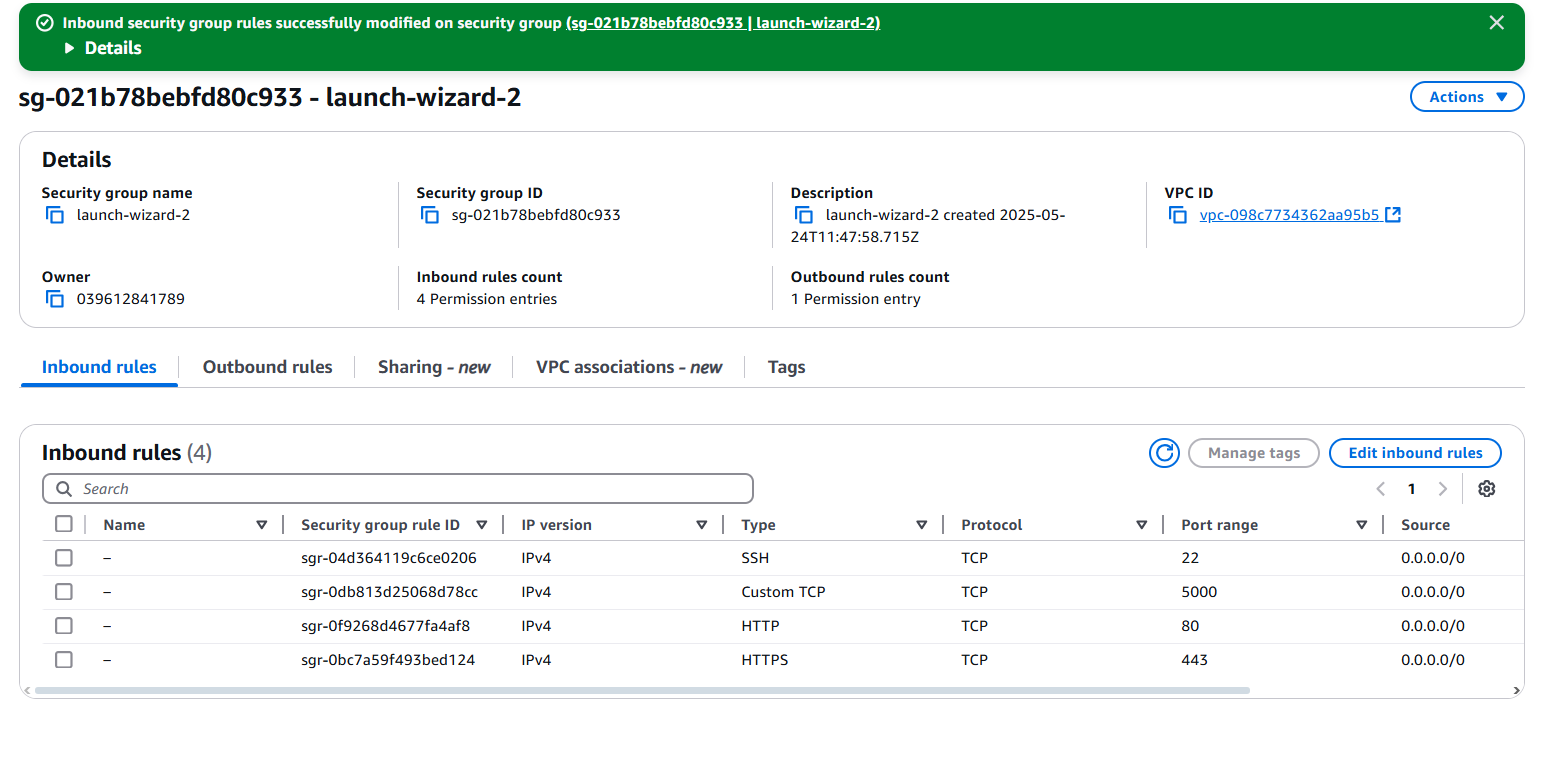
Now go back to the EC2 instance menu, and copy your instance public IPV4 address. Simply use the left side menu. Click on the "instances" link.
As can be seen just below, my public IPV4 instance address is: "13.60.96.165".
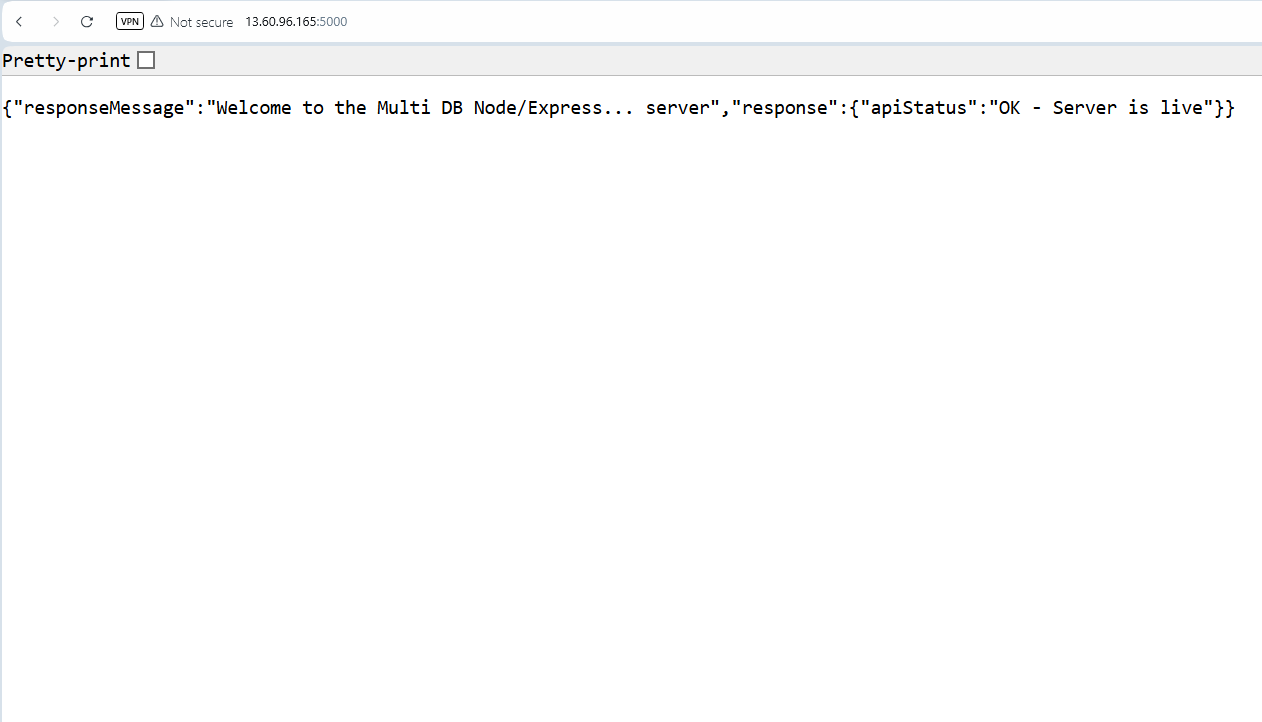
Now head to you browser, and add the following address to it: http://your-instance-IPV4-address:port-number. In my case, that will be: http://13.60.96.165:5000
As you can see in the below screenshot, my request was successful, and the API server is actually running and returning a response.
7. Install Nginx, set up as reverse proxy, and access the API server through it. Follow up and close the VM port 5000.
Earlier on, we opened the VM port 5000 without any restrictions. That is an insecure practice that puts the VM in the way of some serious security threats. A way to remedy for that, is to install and route our connection via a reverse proxy. For that, we'll be using Nginx.
Nginx (pronounced "engine-x") is a high-performance, lightweight web server and reverse proxy used to serve web content, handle load balancing, manage SSL, and route traffic efficiently.
Nginx use-cases:
-
As a web server – Serves static content like HTML, CSS, images, JS.
-
As a reverse proxy – Forwards client requests to backend servers (e.g., Node.js, Python).
-
As a load balancer – Distributes traffic across multiple servers for better performance and reliability.
-
For SSL termination – Handles HTTPS encryption before passing traffic to your app.
-
Caching – Caches responses to reduce load on backend services.
When we install Nginx on our server it sits in front of all direct http connections to our server. With that, we're able to re-route traffic internally with it - thereby having it serve the function of a "reverse-proxy". In our case, that means we'd then be able to redirect traffic to our VM port 5000 without needing to open that port as we did earlier.
Earlier on, even though I didn't need to, I opened that VM port 5000, to help you fully grasp the flow of things.
Now, let's install Nginx, make good use of it, and close up the opened VM port 5000.
- Terminate the API server if it is still running - CTRL + c.
Simply re-connect your instance in case you see a client_loop: send disconnect: Connection reset by peer error at any point.
- Install Nginx.
1sudo apt install nginx -y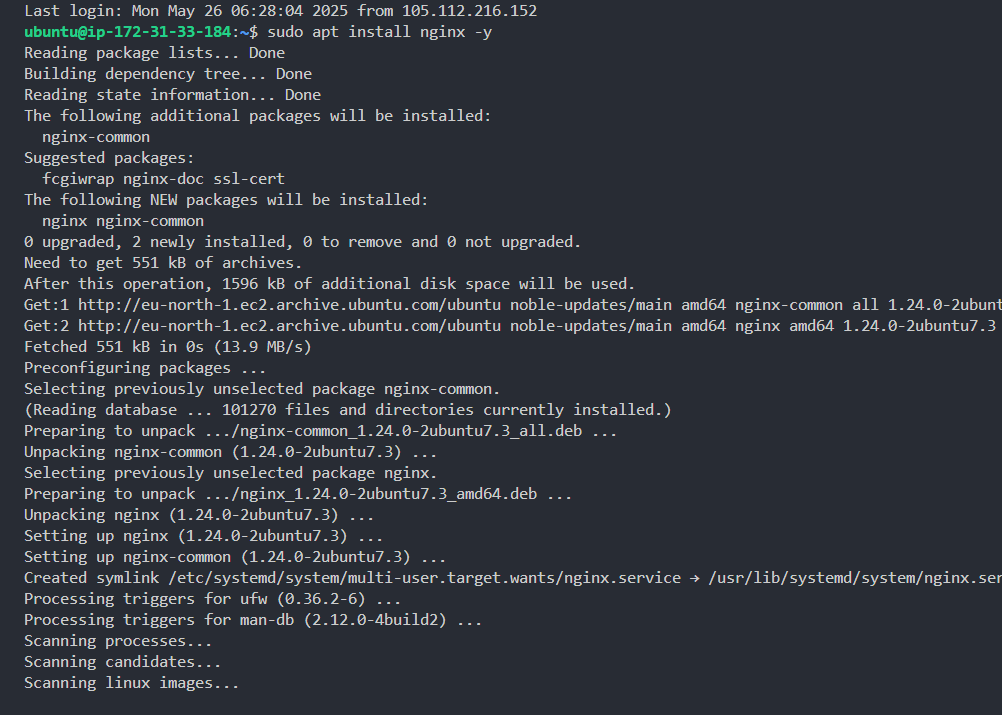
- Refresh/Reload the system service manager - run the below commands.
1sudo systemctl daemon-reexecthen
1sudo systemctl daemon-reload- Enable and start the Nginx service.
1sudo systemctl enable nginxthen
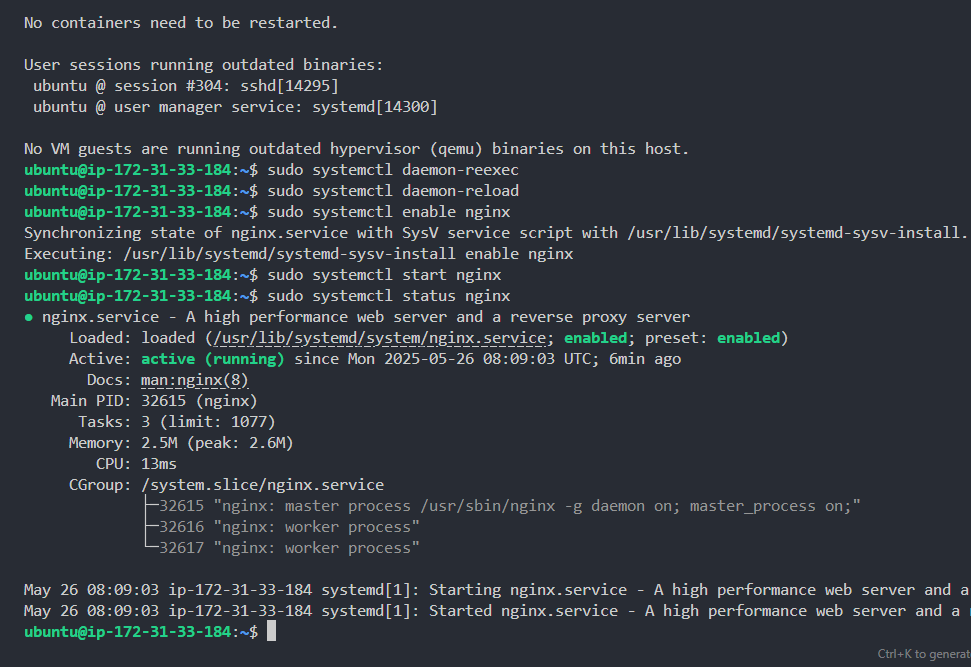
1sudo systemctl start nginx- Now view the status of the Nginx system service.
1sudo systemctl status nginxAs can be seen below, Nginx is running perfectly.
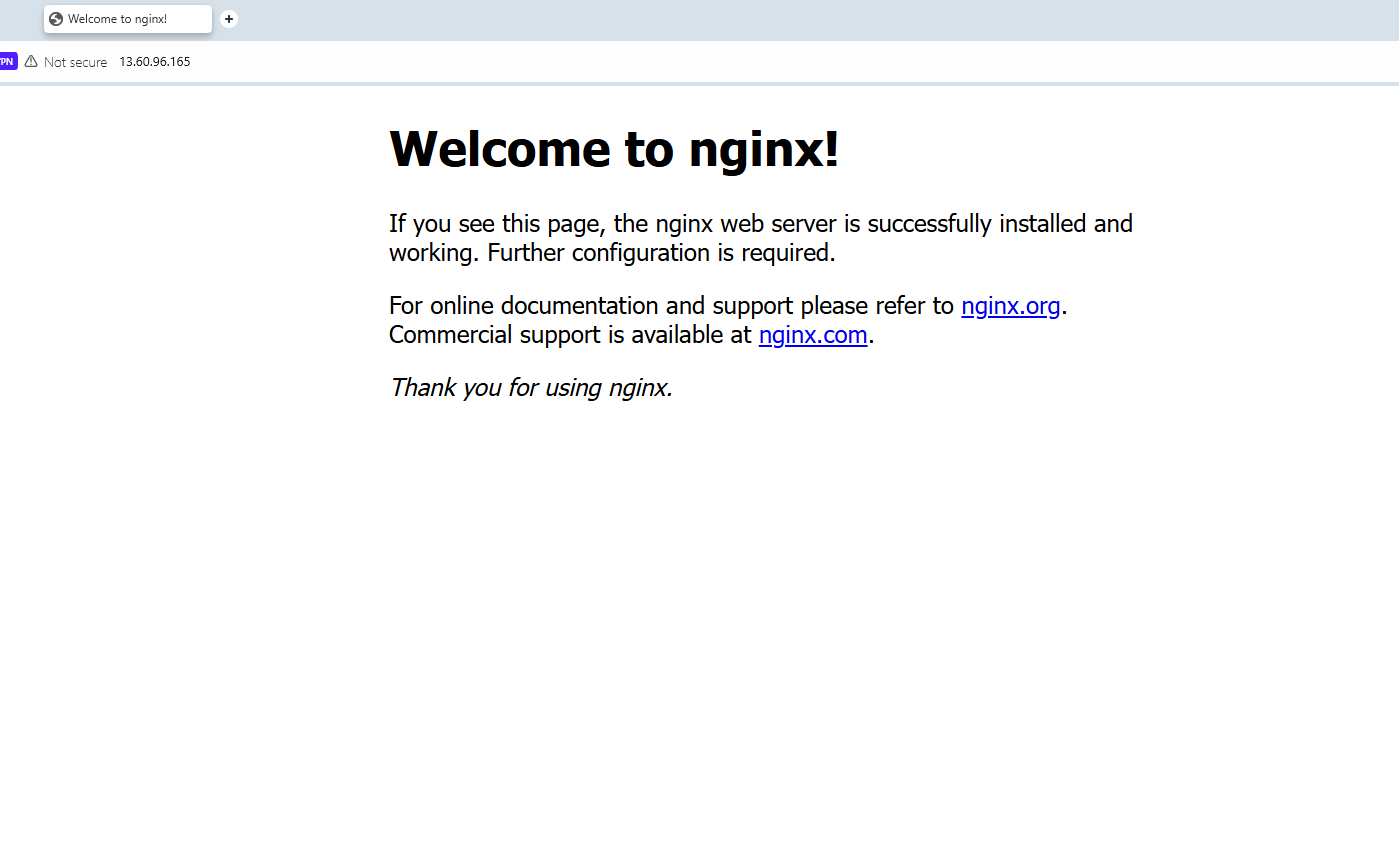
Now visit your VM address directly without the port(http://vm-ip-address). In my case, that will be: http://13.60.96.165.
You can see that Nginx is now sitting in front and intercepting all http connections.
Now that we have Nginx set up, let's configure it to handle routing to our port 5000 internally, so we can close up The open VM port 5000.
- Open the Nginx config file using the Nano CLI editor.
1sudo nano /etc/nginx/nginx.conf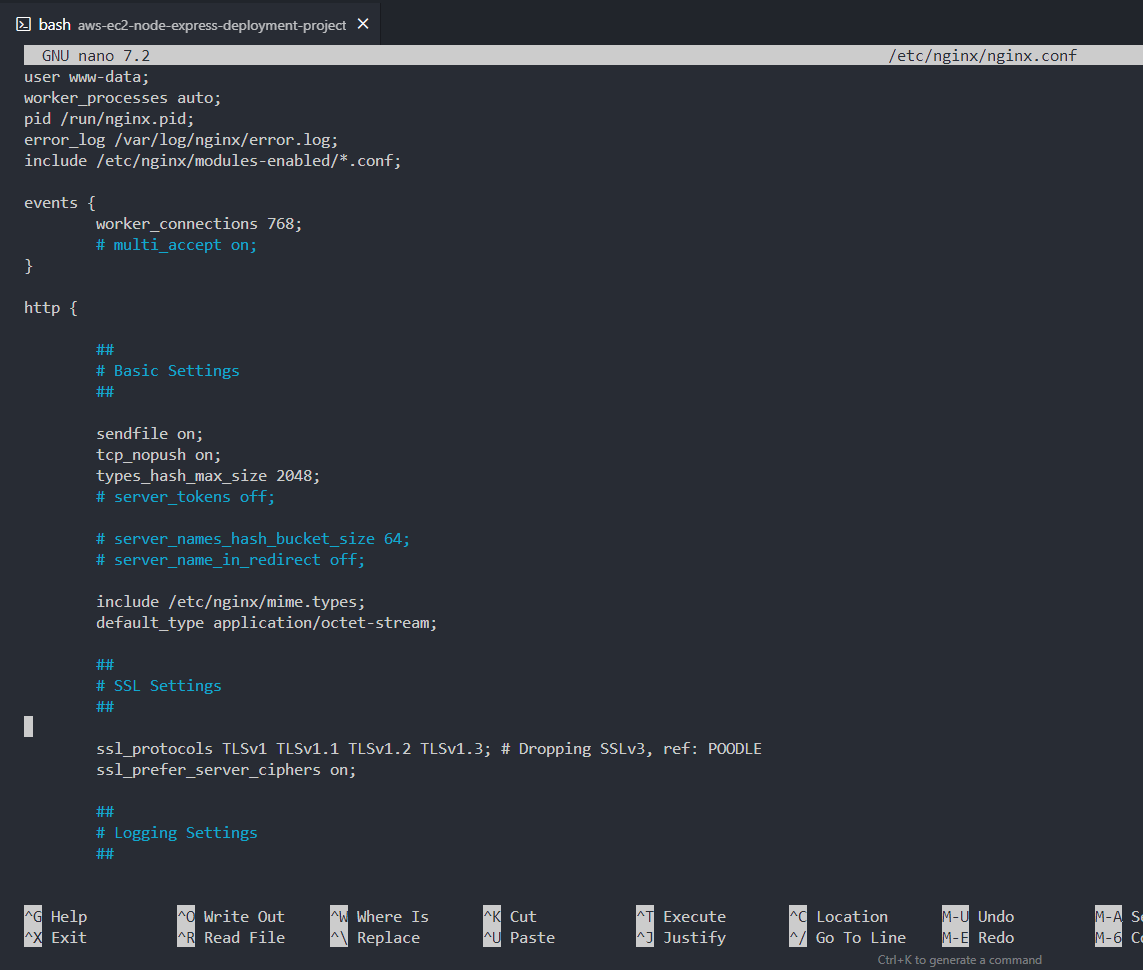
- First thing, scroll(if you have a limited screen) and locate the line with this text - "include /etc/nginx/sites-enabled/*;", then add a hash tag in front of the line to comment it out.
I.e.
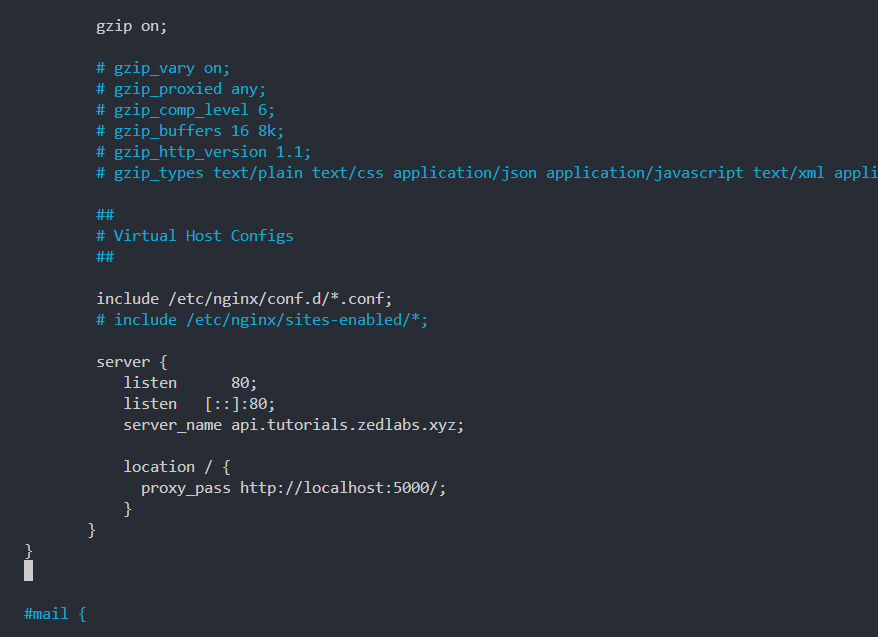
1# include /etc/nginx/sites-enabled/*;- Secondly, add the snippet below just after that line.
1
2server {
3  listen      80;
4  listen   [::]:80;
5  server_name api.tutorials.zedlabs.xyz;
6
7  location / {
8      proxy_pass http://localhost:5000/;
9  }
10}
11
The above snippet does two things.
- It prepares our Nginx setup, to help us with getting a free SSL certificate for our domain or subdomain("api.tutorials.zedlabs.xyz" in my case).
- It handles reverse-proxying our http traffic to port 5000.
With some proper spacing arrangements, your Nginx config additions should look like this:
-
Save and exit Nano - CTRL + o then press Enter then CTRL + x
-
Refresh/Reload the system service manager - run the below commands.
1sudo systemctl daemon-reexecthen
1sudo systemctl daemon-reload- Restart the Nginx service.
1sudo systemctl restart nginxNow let's restart our API server and visit out VM IP directly(without the port number), you'll see that instead of the Nginx home-screen that was initially showing due to Nginx intercepting our http traffic, we'll now be automatically re-directed to our API server.
That will simply mean Nginx is now serving as our reverse proxy.
- Restart the API server.
1npm run dev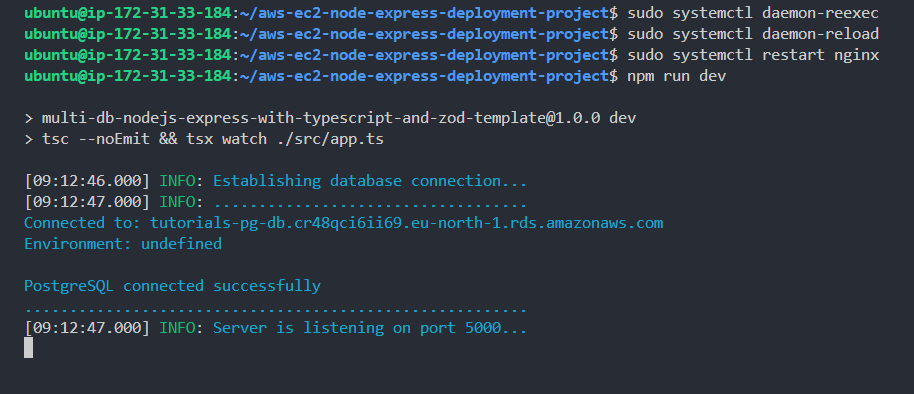
Ensure to be inside of the project(the git repo - "aws-ec2-node-express-deployment-project") directory else you'll get an error. Carefully take note of that, in-case you lost your SSH connection at any point.
- Visit the IP address - directly without the port. I.e. http://13.60.96.165 in my case.
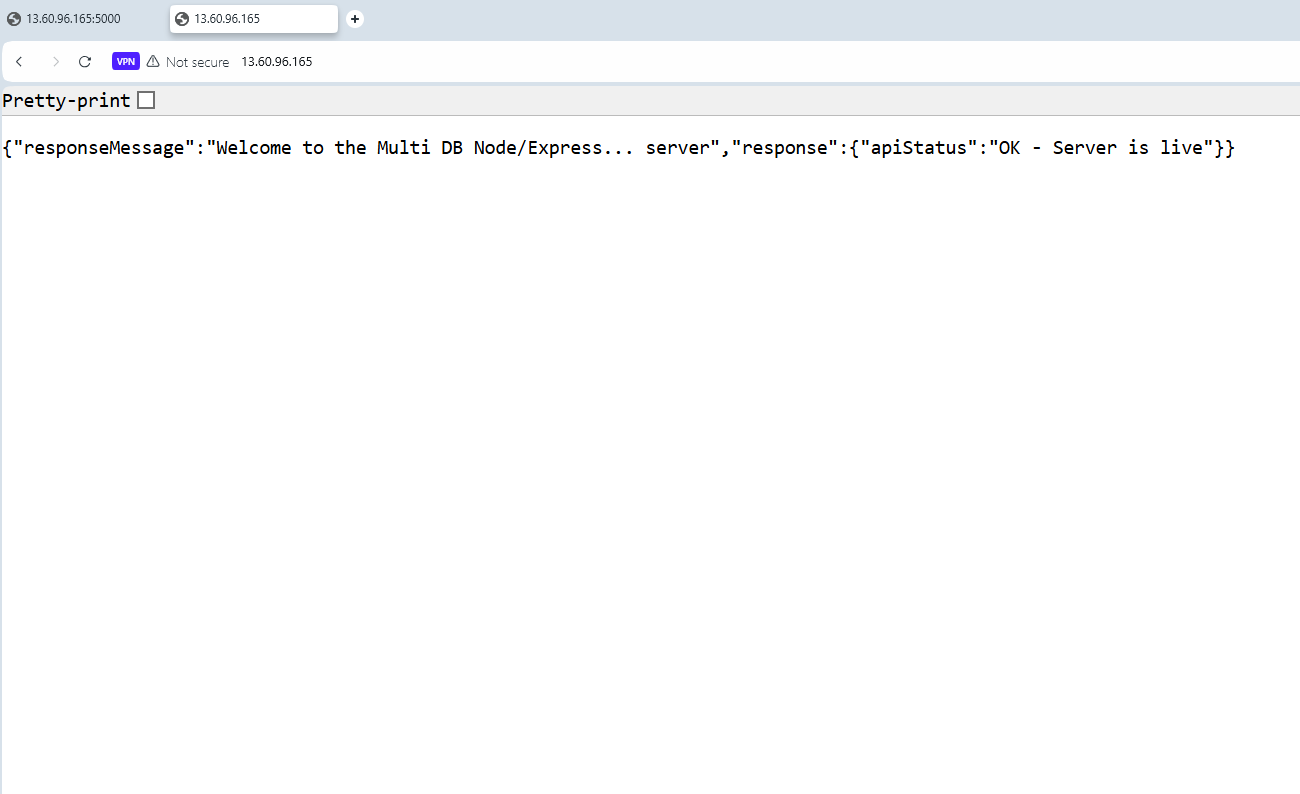
Just as stated, our reverse proxying is now working perfectly.
8. Get a free SSL certificate for project domain(sub-domain).
As stated earlier, we already prepared Nginx to help us get a free SSL certificate for our domain/sub-domain(api.tutorials.zedlabs.xyz) - thanks to Let's Encrypt.
In simple terms: An SSL certificate is a digital file that:
- Encrypts data between a browser and server (HTTPS).
- Proves the website is real (identity verification).
- Uses a public-private key pair.
In a summary(and for what we want), it turns "http://" into "https://" - providing secure connection for http.
Before we proceed to get our SSL certificate, let's point our VM IP to our domain so that we can be able to receive traffic on it instead of using our VM IP address. Nginx will fail to provide the SSL certificate if that is not done first.
To do that, simply go to where ever your domain is hosted, and create an "A" DNS record that points your domain/sub-domain to the VM IP address.
My domain is currently hosted on AWS Route 53.
Route 53 is AWS' DNS management service.
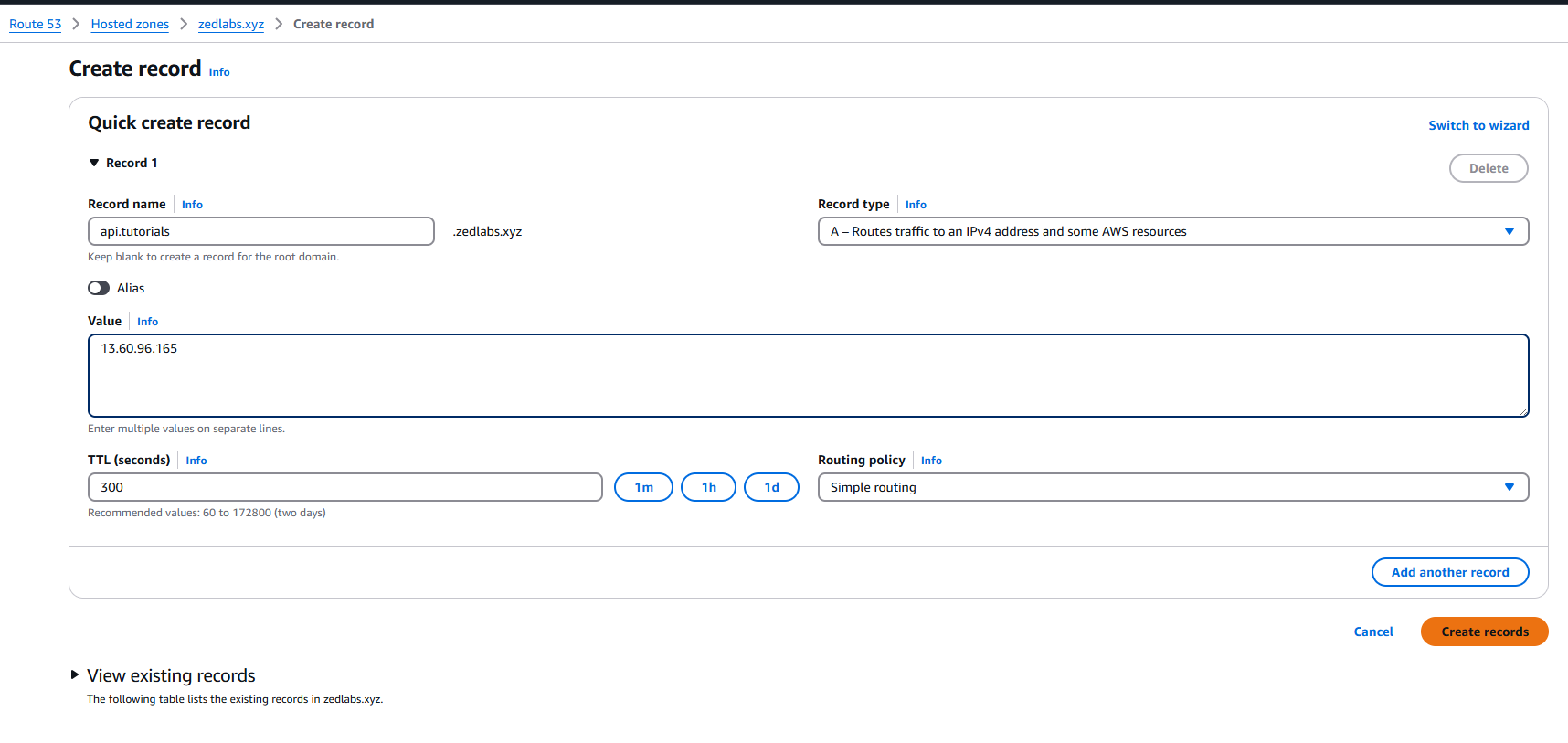
Now visit your domain/sub-domain in a browser, but with "http". "https" will not work yet since we're yet to get an SSL certificate.
You should see that it works perfectly, but with a "Not Secure" warning from the browser.
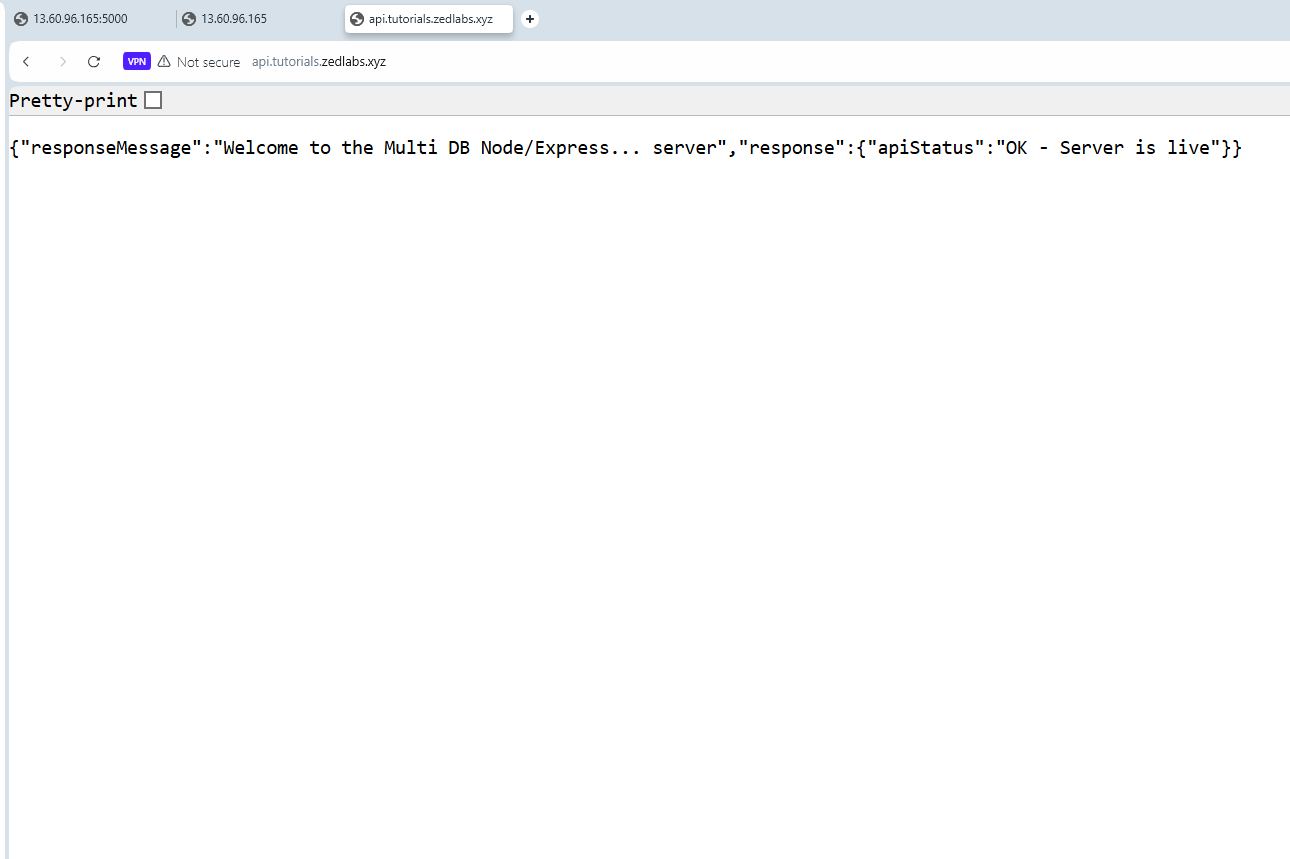
Now stop the API server, and let's get on SSL certificate for our sub-domain.
-
CTRL + c
-
Run the below commands
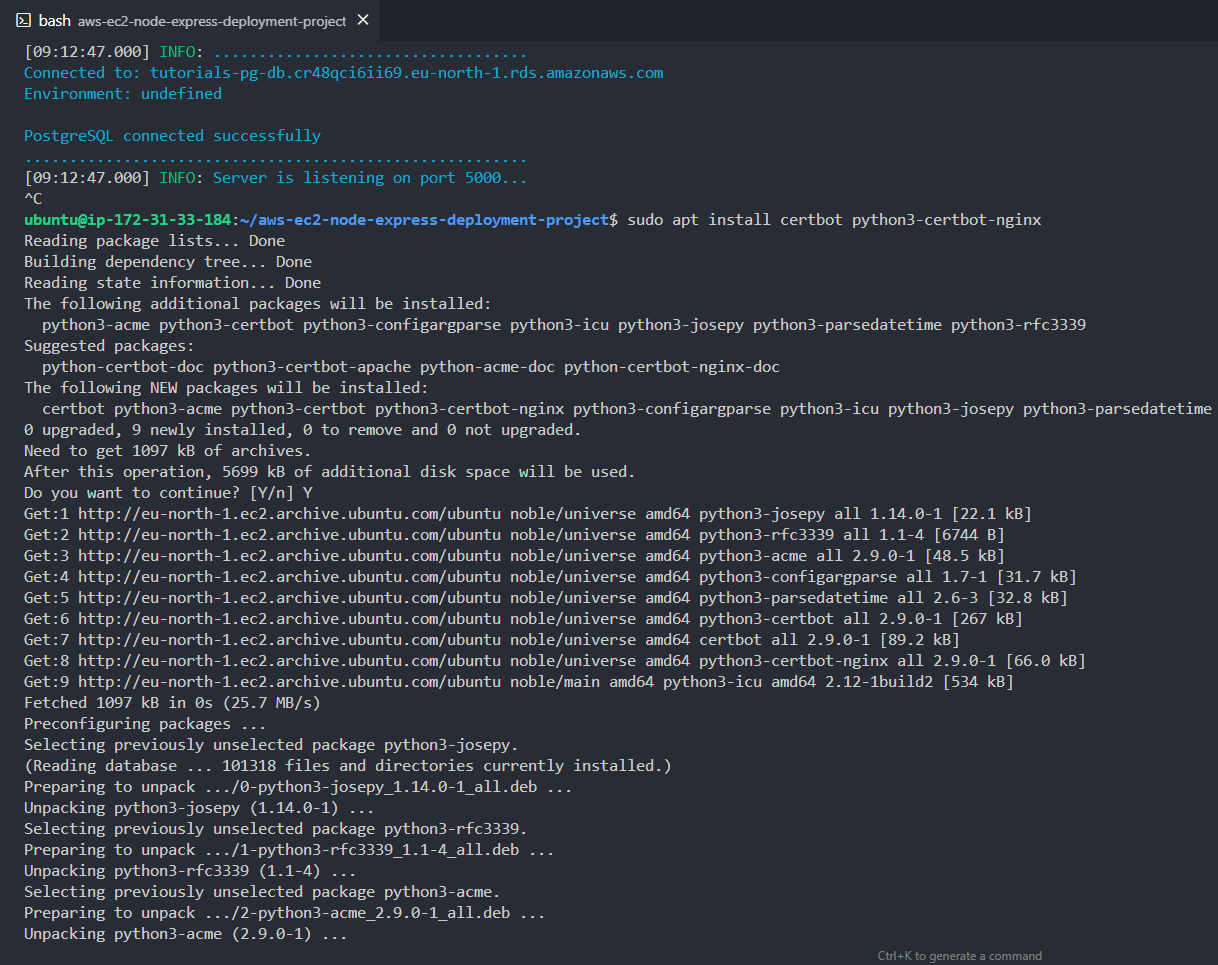
1sudo apt install certbot python3-certbot-nginxYou'll get the below prompt about disk space usage, type "Y" to agree.
Now run:
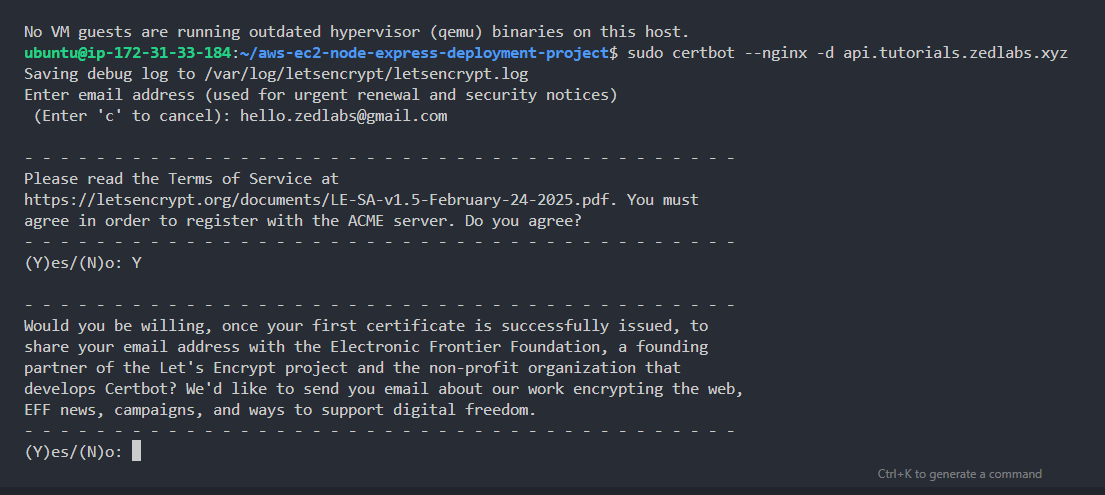
1sudo certbot --nginx -d your-domain-or-sub-domainIn my case, that would be:
1sudo certbot --nginx -d api.tutorials.zedlabs.xyzYou'll be prompted to add an email address, proceed to add one.
You'll get another prompt asking you to read and agree to the Let's Encrypt terms. Read and agree by typing a "Y".
One more email marketing-related prompt, Type "Y" to agree.
You should then see a success message that looks similar to the one below.
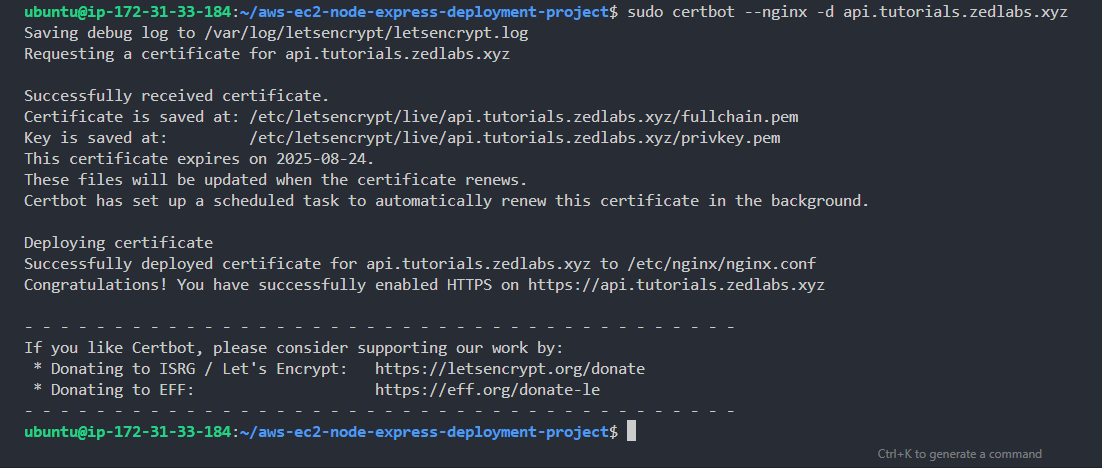
Congratulation!!! You just successfully got a free SSL certificate for your domain/sub-domain.
9. Test API server on the now SSL certified domain/sub-domain.
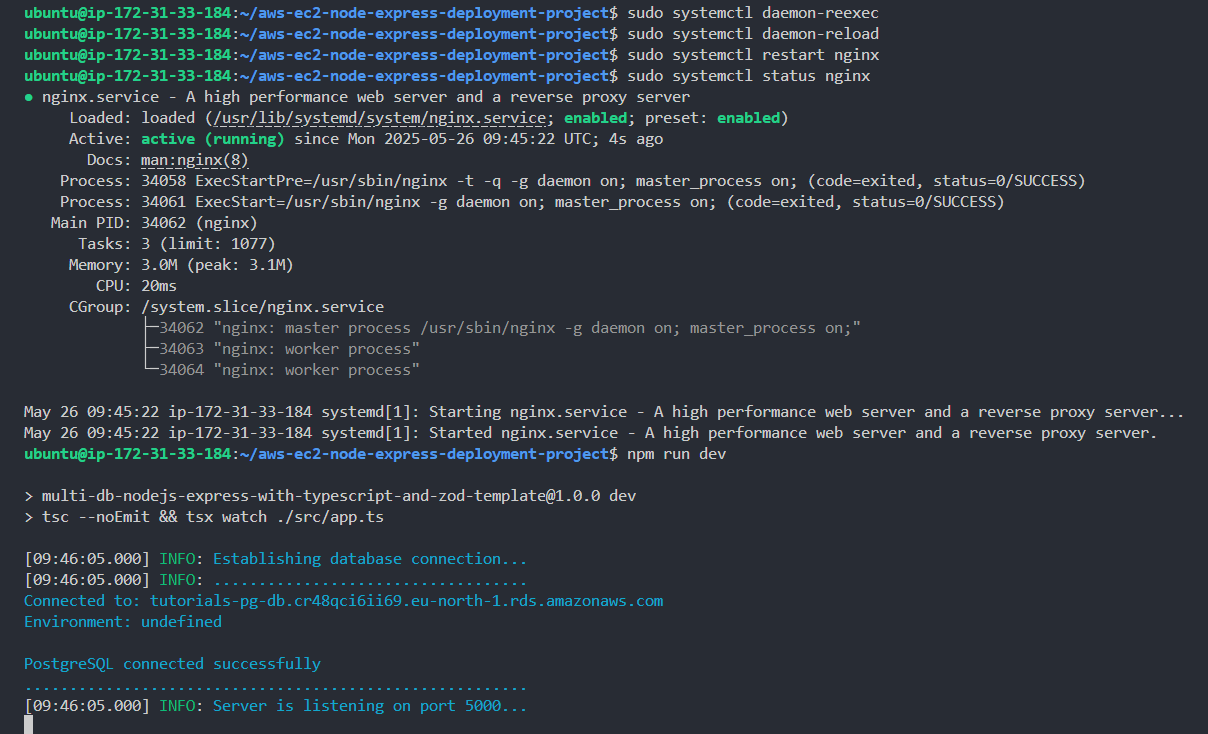
- Refresh/Reload the system service manager - run the below commands.
1sudo systemctl daemon-reexecthen
1sudo systemctl daemon-reload- Restart the Nginx service.
1sudo systemctl restart nginx- Check the Nginx service status.
1sudo systemctl status nginx- Restart the API server server
1npm run devOnce again, ensure to be inside of the project(the git repo - "aws-ec2-node-express-deployment-project") directory before trying to restart the API server else you'll get an error.
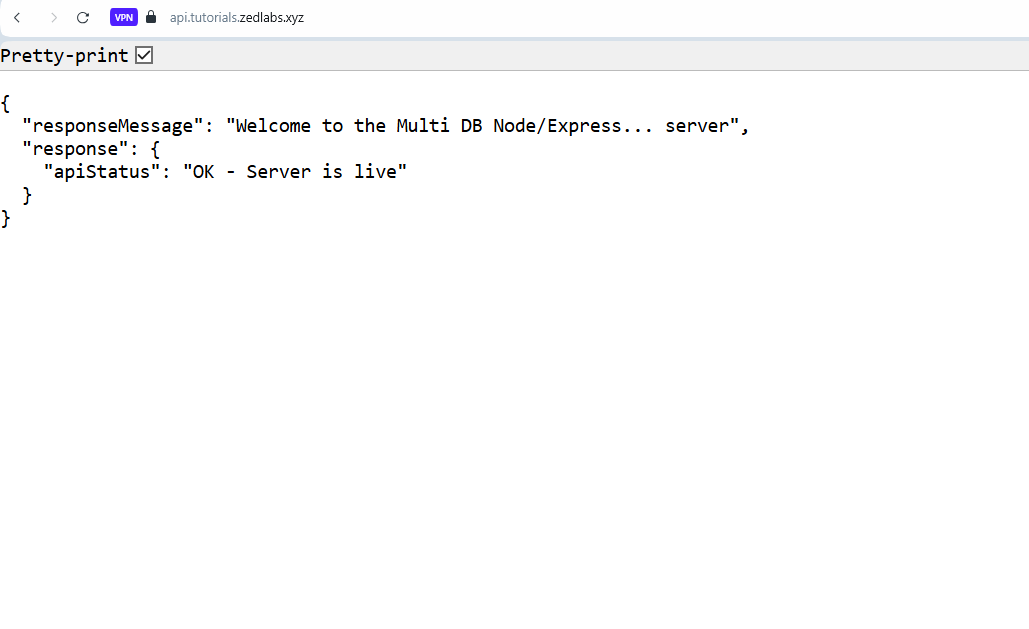
Now return to your browser, and try out an "https" connection with you domain/sub-domain. It should work just perfectly as mine below. No more "Not Secure" warnings.
Now Let's return to the security groups page on AWS, and close the VM port 5000 since we no longer need it. Hence also keeping our VM as secure as possible.
Simply click the delete button, and remove the rule that permits access to the VM port 5000.
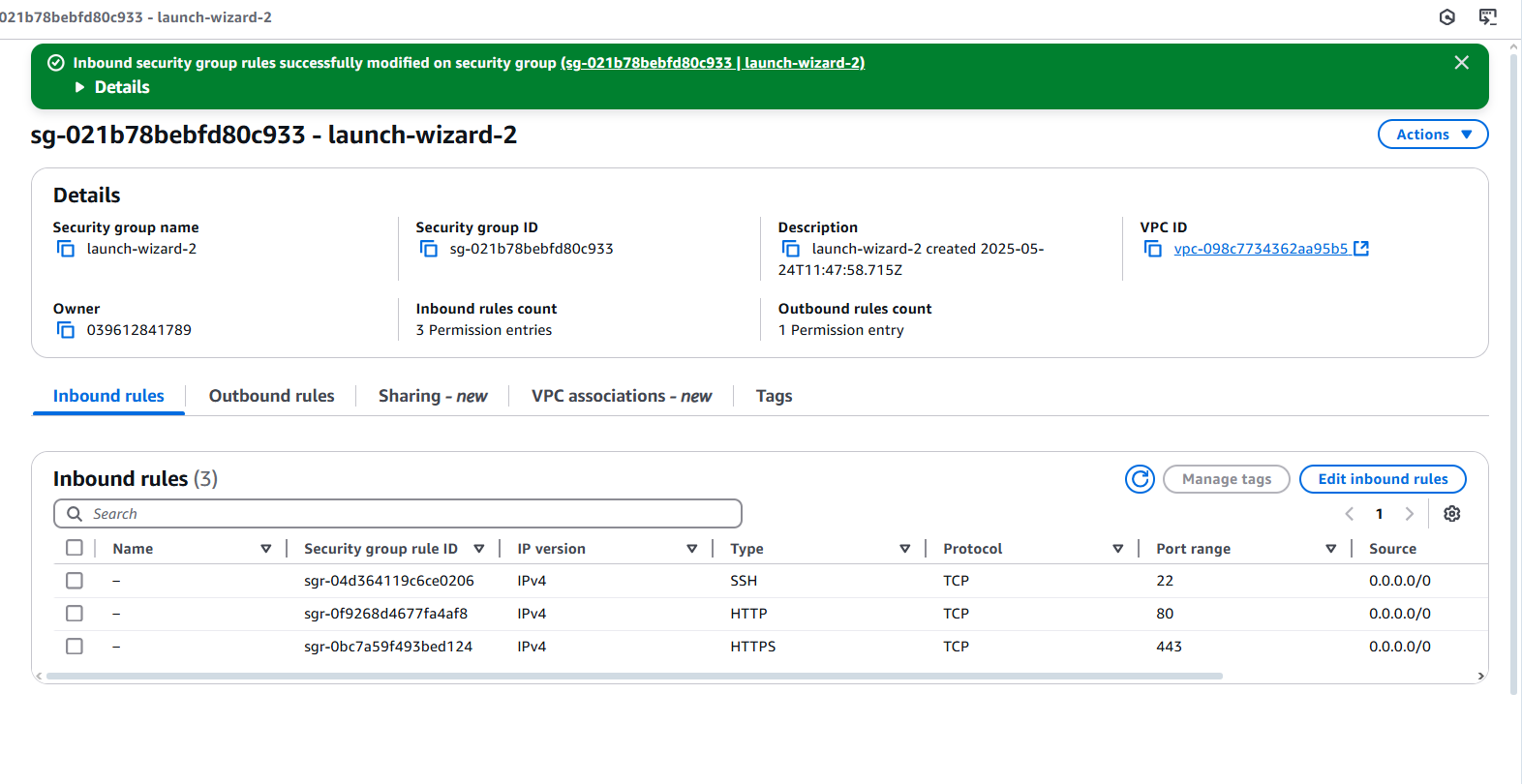
Then save.
10. Explaining what happens with the current setup if something goes wrong.
With the current setup we have, while our API server can keep running since the VM will always be up, what happens if a breaking-error occurs on it. What happens if something terrible goes wrong.
If any such issues come up, our API server will simply crash with no system in place to restart it.
That is where a tool like Systemd comes in handy once again. Another popular but less powerful alternative tool we could use is PM2.
But stated just above, Systemd is a lot more powerful and capable option.
We'll now simply create a system service to ensure that our API server is always up.
11. Set up a system service(for server persistence) using Systemd.
Run the below command to initialize the creation of the system service using Nano.
1sudo nano /etc/systemd/system/node-express-tutorial-deployment.serviceAdd the following into the Editor.
1
2[Unit]
3Description=Tutorial Project System Service
4After=network.target multi-user.target
5
6[Service]
7User=ubuntu
8WorkingDirectory=/home/ubuntu/aws-ec2-node-express-deployment-project/build
9ExecStart=/home/ubuntu/.nvm/versions/node/v22.16.0/bin/node /home/ubuntu/aws-ec2-node-express-deployment-project/build/app.js
10Restart=on-failure
11RestartSec=10
12Environment=NODE_ENV="production"
13EnvironmentFile=/etc/secrets.env
14StandardOutput=syslog
15StandardError=syslog
16SyslogIdentifier=PlatformCore01
17
18[Install]
19WantedBy=multi-user.target
20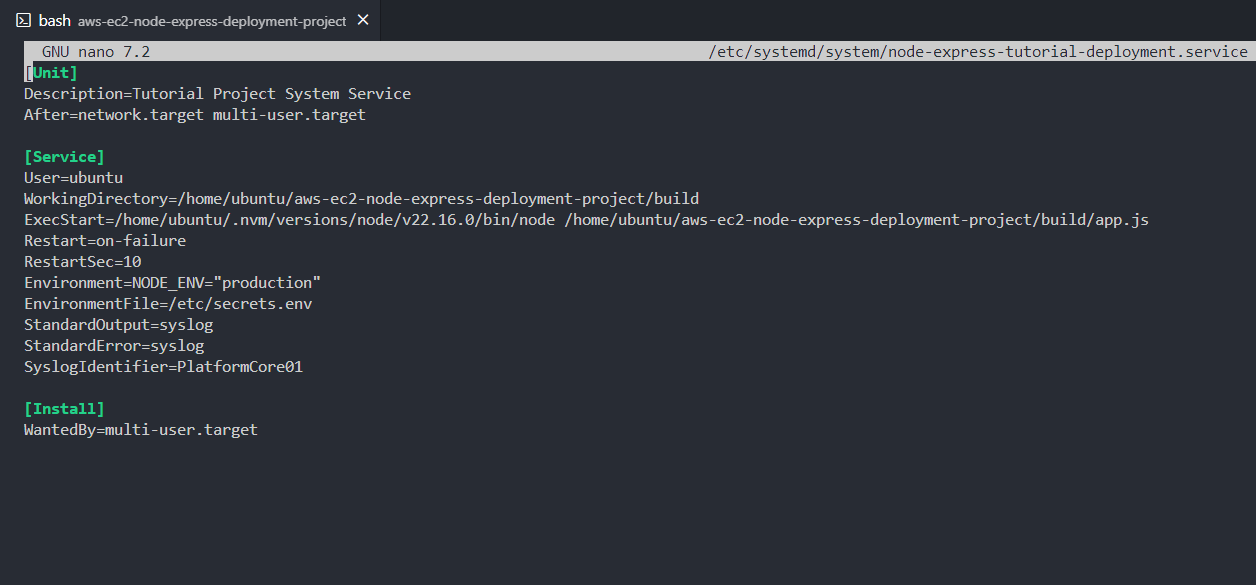
- Save and exit Nano - CTRL + o then press Enter then CTRL + x.
The above systemd service file defines how to run a Node.js app as a background system service on Linux. Below is a concise breakdown:
[Unit] section:
-
Description: Describes the service.
-
After=network.target multi-user.target: Waits until network and system are ready.
[Service] section:
-
User=ubuntu: Runs as the ubuntu user.
-
WorkingDirectory=...: Sets the working directory (app folder).
-
ExecStart=...: Starts the Node.js app with the specified version(which is the one we installed earlier), and entry file (app.js).
-
Restart=on-failure: Restarts only if the app crashes.
-
RestartSec=10: Waits 10 seconds before restart.
-
Environment: Sets NODE_ENV to "production".
-
EnvironmentFile: Loads additional environment variables from /etc/secrets.env.
-
StandardOutput=syslog and StandardError=syslog: Logs output to the system log.
-
SyslogIdentifier=PlatformCore01: Tags log entries for easier identification.
[Install] section:
- WantedBy=multi-user.target: Enables the service at boot in standard (non-GUI) mode.
In short: The file tells systemd how to run and manage the Node.js app as a persistent, auto-restarting service.
12. Finish deployment, and test API server on the live URL - inside Postman.
Now that we have our system service all set, let's create the environmental service file that will work on the service. As seen in the service file content, our environmental variables will be at "/etc/secrets.env".
- Open the file with Nano.
1sudo nano /etc/secrets.env-
Add all the original ".env" file content into it - just like you did for the previous one we created.
-
Save and exit Nano - CTRL + o then press Enter then CTRL + x
Earlier on, I stated that adding a .env file directly on our project(as we earlier did) was insecure. This new setup keeps our systems more secure as bad actors will not easily detect where secrets are stored on our VMs. Ensure to only place your secret in locations that can keep them as secure as possible.
- Now let's delete the initial env file we created(ensure to be on the project root - inside the repo).
1sudo rm -rf .env- Ensure that the deletion was successful.
1cat .env
You should see that the file no longer exist - as in the screenshot below.
- Refresh/Reload the system service manager - run the below commands.
1sudo systemctl daemon-reexecthen
1sudo systemctl daemon-reload- Enable the API server system service.
1sudo systemctl enable node-express-tutorial-deployment.service- Start the service.
1sudo systemctl start node-express-tutorial-deployment.service- Check the service status.
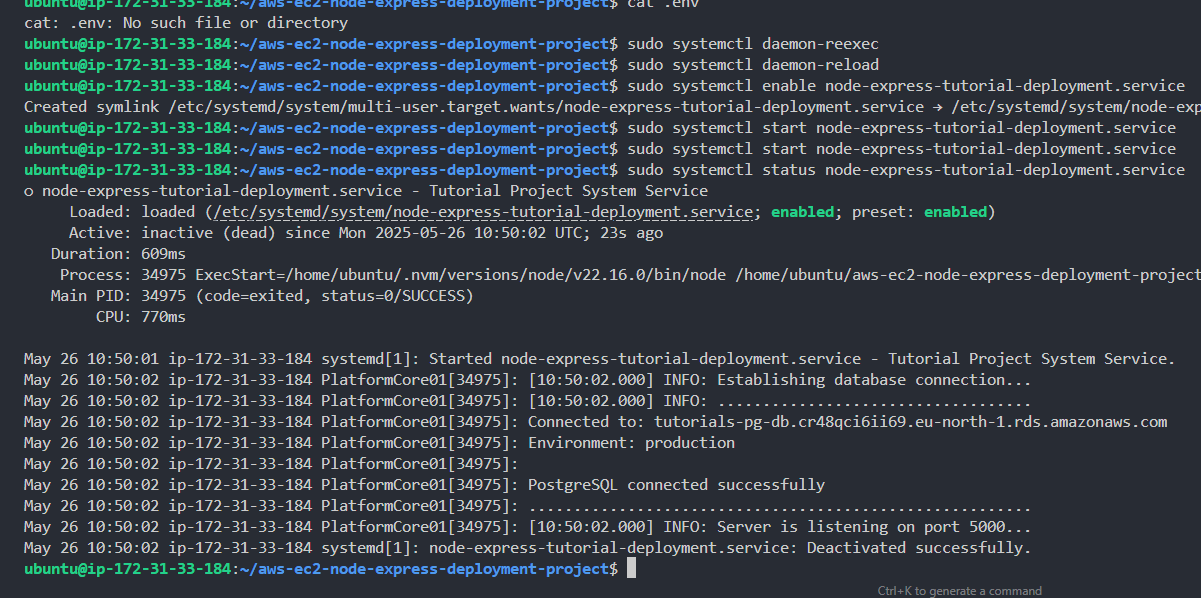
1sudo systemctl status node-express-tutorial-deployment.serviceAs can be seen in the system service log below, your NodeJs API server is now successfully running as a system service.
Our API should also be responding perfectly.
With this, even when you're there is any breaking error, the system service will attempt to restart the API server without needing any manual intervention.
- View the API server system service logs whenever you need to.
1sudo journalctl -u node-express-tutorial-deployment.serviceOr
1sudo journalctl -fu node-express-tutorial-deployment.serviceNow let's proceed to postman, and test the API end-points with the live URL.
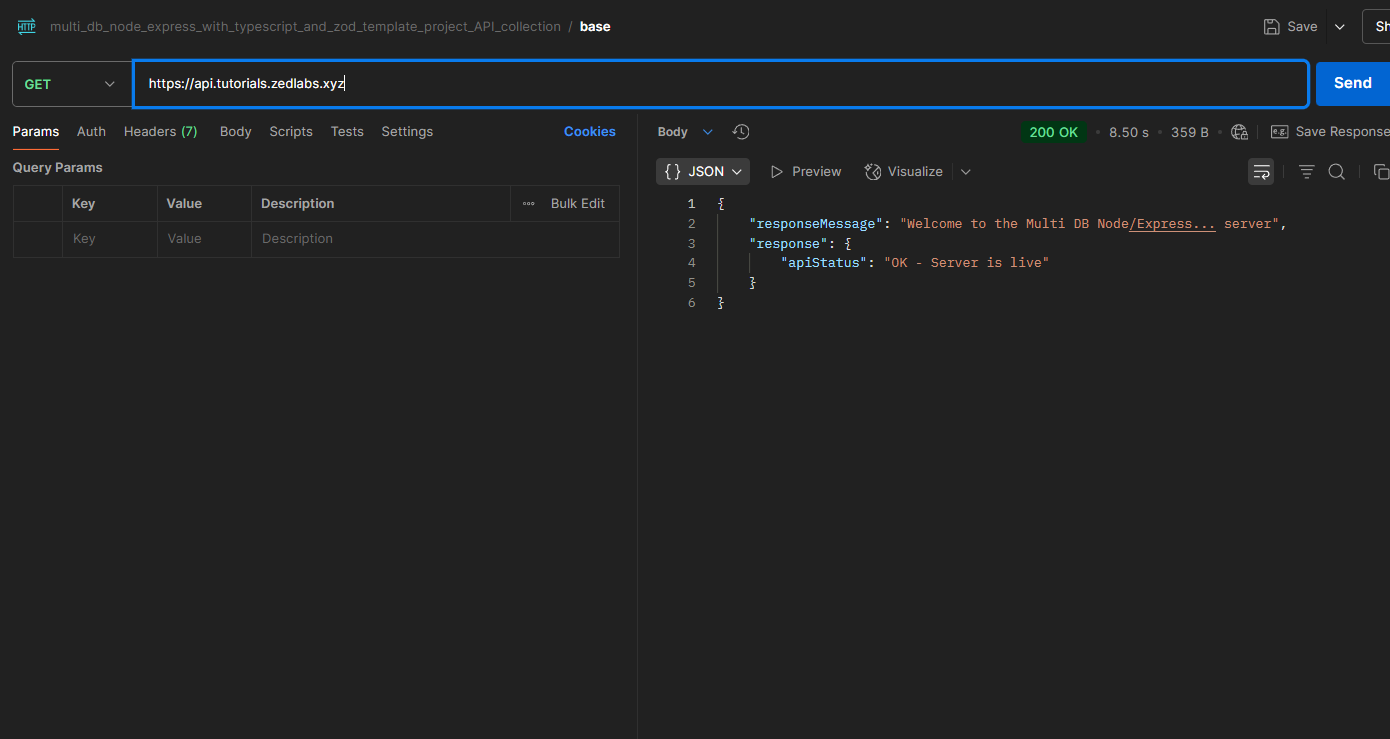
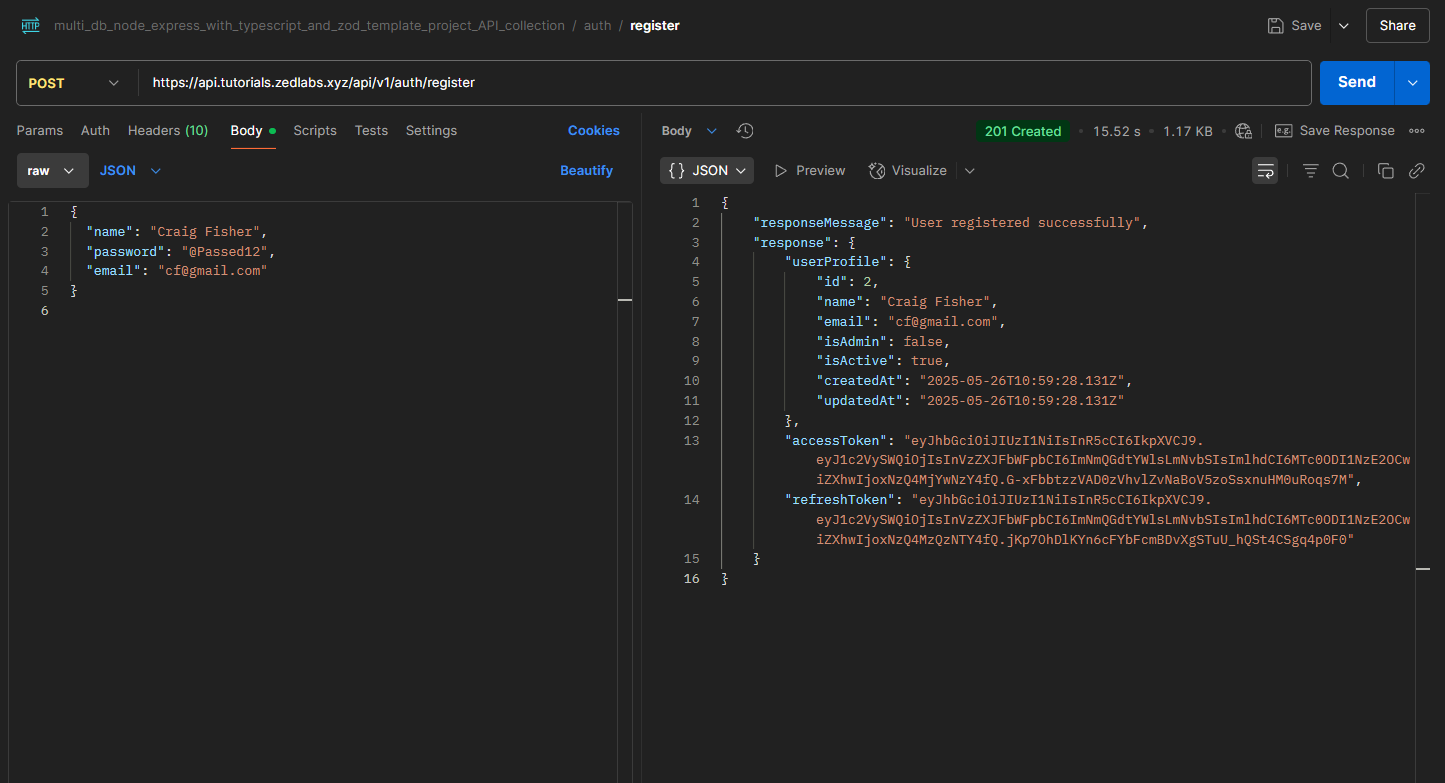
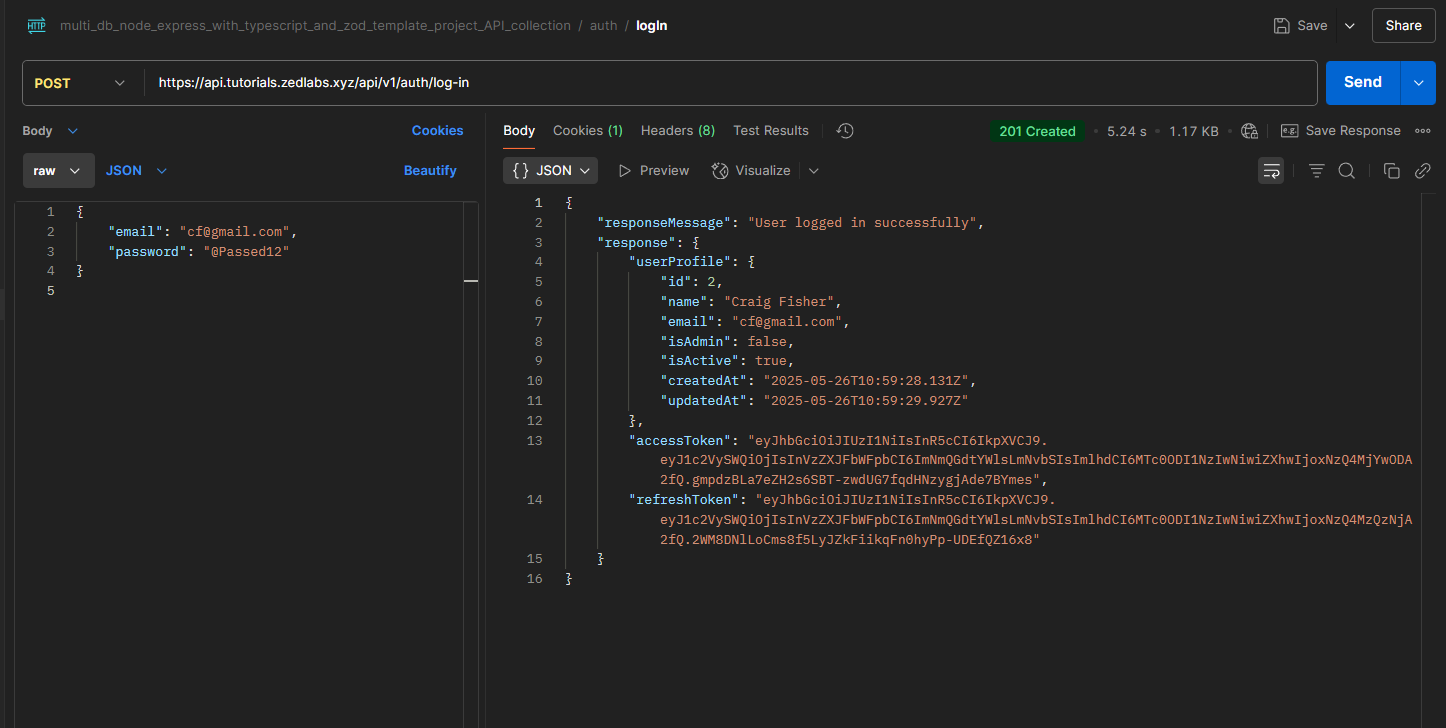
It all works perfectly!!!
Just like that my friend, you just successfully created a standard and complete NodeJs API server deployment on AWS EC2.
The limitation of this kind of cloud deployment.
While this API server deployment is superb and mind-blowing enough, it is still limited in the sense that, on every code/deployment update made to the project repository, the engineer in-charge still needs to:
- log into the EC2 instance, to pull in the code.
- Restart the system service.
1sudo systemctl restart node-express-tutorial-deployment.service- Also view it's status to be sure it's okay.
1sudo systemctl status node-express-tutorial-deployment.service- As I'll recommend, also restart Nginx.
1sudo systemctl restart nginx- And also view it's status to be sure it's okay.
1sudo systemctl status nginxAll of these processes, are not ideal and can be really tedious for engineers.
What if the engineer in charge is not available. That simply means all the code/feature deployments will remain on hold till he or she returns.
The solution to this bottleneck, is to simply implement proper CI/CD pipelines that can automate deployments without any manual human intervention.
All of that and more will be covered shortly in a subsequent Zed Labs blog series, that will teach how to set up complete CI/CD pipelines with Jenkins and Github.
You sure don't want to miss that.
Hire the Zed Labs Team - Let's bring your software and design projects to life.
We've still got project/client slots for this month. The team at Zed Labs is open to having you on board, and making you a happy client. We look forward to collaborating with you on any web or design project you have.
-
If you would love to have us build awesome stuff for you, simply visit our website, and fill the contact form. Alternatively, you can send us an email here: hello.zedlabs@gmail.com.
-
You can also send me a private email at okpainmondrew@gmail.com or a DM via Linkedin - just in case you prefer to contact me directly.
We'll be excited to hop on a call and get on the way to bringing your software or design project to life.
Conclusion.
That would be it for this article.
It's been quite a lot in this guide, I do hope you found much value.
If you loved this post or any other Zed Labs blog post, and would love to send an appreciation, simply use this link to buy us some cups of coffee 🤓.
Thanks for reading.
Cheers!!!
