

Detrudr is a DevSecOps HTTP traffic-anomaly/DDOS detection and counter engine, that runs beside any containerized server/application that needs to be protected, tails nginx JSON access logs in real time, learns a rolling traffic baseline, detects suspicious spikes, blocks abusive IPs with iptables, and exposes a live dashboard.
What Detrudr Does(In Plain Terms).
At a high level, the flow of Detrudr's operation is:
The goal is not to replace enterprise WAFs or high-end security products.
The goal is to have a focused, understandable layer that can react quickly enough to reduce damage during abuse spikes.
The Core Architecture.
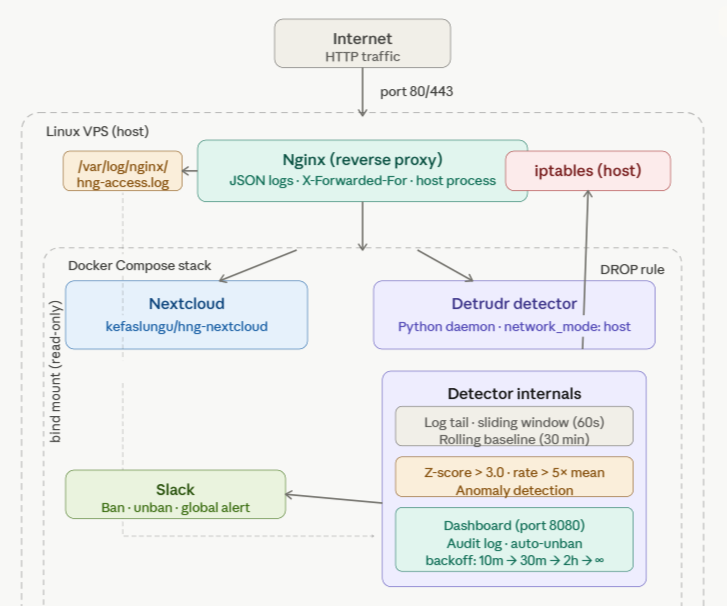
1: Traffic Ingestion From Nginx Logs.
Detrudr does not sit directly in the request path. It reads from Nginx access logs.
That keeps the system simple and resilient. Nginx already sees all inbound traffic, so using its log stream avoids extra in-path complexity.
Each line includes fields like:
source_iptimestampmethodpathstatusresponse_size
Each parsed line becomes an event the detector can reason on.
2: Sliding Window Tracking.
One of the most important internals is the 60-second sliding window powered by Python deques.
On each new request:
- the request timestamp is appended
- timestamps older than 60 seconds are dropped
This keeps every metric "fresh" by default.
Why not fixed one-minute buckets?
Because bucket boundaries can hide spikes. Sliding windows continuously answer:
"What happened in the last 60 seconds from right now?"
Detrudr keeps:
- one global request deque
- one per-IP request deque
- one per-IP error deque(for 4xx/5xx)
This supports both global pressure checks and fine-grained per-IP behavior checks.
3: Rolling Baseline Learning.
Static thresholds are dangerous because normal differs from server to server.
So detrudr keeps a rolling baseline(from recent traffic samples) and recalculates statistics such as:
- mean
- standard deviation
- sample count
This allows detection to be relative to local reality.
Hour-Aware Sampling.
A useful detail in this build is hour-aware sampling. Traffic at 2 AM is often very different from traffic at 2 PM.
When enough data exists, detrudr prioritizes samples from the current hour slot; otherwise it falls back to broader recent windows.
Startup Safety Floors.
At startup, data is thin. Without safety floors, almost any traffic can look anomalous.
To avoid noisy false positives, detrudr uses minimum floor values for baseline parameters during warm-up and low-volume periods.
4: Detection Logic(Global + Per-IP).
Detrudr combines two practical signals:
- Z-score
- Rate multiplier
A request pattern is flagged when either signal crosses configured limits.
Global Anomaly Checks.
Global checks look at total incoming traffic and send alerts when server-wide behavior spikes abnormally.
Per-IP Anomaly Checks.
Per-IP checks are the enforcement path. If one source IP diverges sharply from its baseline, the IP can be banned.
Error-Weighted Tightening.
Detrudr also tracks per-IP error ratios(4xx/5xx). When error-heavy behavior rises above normal, thresholds are tightened for that IP.
That helps catch path probing and hostile retries earlier than volume-only detection.
5: Automated Blocking With iptables.
Once an IP is classified as abusive, detrudr inserts a drop rule.
And when ban duration expires:
This closes the loop from detection to immediate response.
Why Progressive Bans.
Immediate permanent bans are often too aggressive for real systems.
I used a simple escalating schedule:
- First strike: 10 minutes
- Second strike: 30 minutes
- Third strike: 2 hours
- Repeated abuse: permanent ban
This keeps enforcement practical: firm on abuse, but not reckless on first anomalies.
Monitoring, Auditability, And Visibility.
Defense automation is only trustworthy when you can inspect what it is doing.
Detrudr includes:
- Slack notifications(bans, unbans, global anomaly alerts)
- audit logging for decisions and actions
- a lightweight live dashboard
The dashboard shows things like current global request rate, top IPs, active bans, baseline stats, and recent detector events.
For the meantime, the Detrudr dashboard can be accessed at https://detrudr.xentoprotocol.xyz. It's currently set up to protect a project on nextcloud.xentoprotocol.xyz.
Conclusion.
That would be it for this article.
I hope this gave you practical and useful insight into building lightweight traffic defense systems with Python, Nginx logs, and iptables.
Thanks a lot for reading.
If you loved this post and would love to send an appreciation, simply use this link to buy me a cup of coffee.
See you in the next article.
Cheers!!!